ENGINEERING NOTES
To reduce cap scrap after a changeover, restore the known production configuration before tuning the process. Confirm the connected equipment and material, follow the delivered startup procedure, and keep initial output separate until stable conditions and the required cap functions have been demonstrated. Loading yesterday's machine recipe is a starting point, not production release.
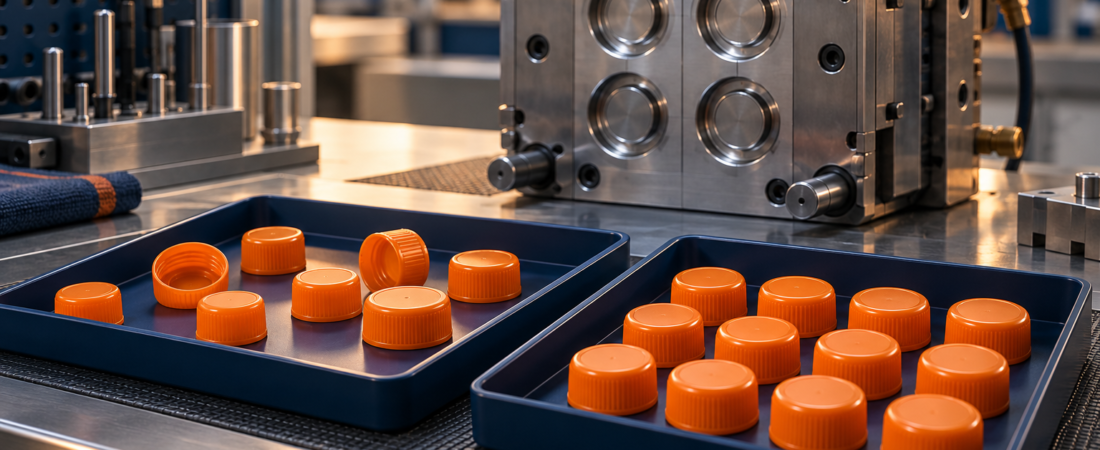
AI concept illustration of sample segregation at restart. The tooling, samples and workstation are invented and do not document a Mincong production result.
This article addresses a previously qualified tool returning to production. A new resin, changed component or different machine may need a wider qualification. It is not a substitute for the machine, mould and hot-runner suppliers' operating instructions or the site's safety procedures.
Correct installation differences before adjusting the recipe
Verify that the installed mould, active cavity arrangement, material and colour match the approved setup. Review cooling connections and delivered flow, heating-zone identification, valve-gate actuation where fitted, and the receiving or closing equipment. An incorrectly connected circuit is an installation problem; changing the moulding recipe around it can make the cause harder to find.
Qualified personnel should correct connection or equipment faults through the site's authorised procedures. Do not improvise electrical wiring, force a valve pin or bypass machine safeguards to accelerate a restart. YUDO's handbook identifies system wiring, actuation and heating as defined system requirements, not interchangeable accessories.
Use the startup route for the actual system state
An empty hot runner, a filled runner after a short pause and a system returning from a long shutdown may require different treatment. Use the delivered supplier's instructions and the actual resin requirements. Mold-Masters' Sprint manual, for example, differentiates startup conditions and requires the relevant heating and cooling readiness before injection. Its numerical procedure must not be copied to every cap tool.
Resolve a temperature alarm or uncertain valve response before continuing. Repeatedly injecting while waiting for a questionable zone to recover can produce scrap without establishing the correct operating state. The current system manual and support contact should be available to the operator.
Allow the process to settle without chasing every first-shot result
Keep restart samples apart from released production and compare the relevant process response with the accepted baseline. RJG explains why controller settings do not always reproduce the same cavity conditions after equipment changes, wear or calibration differences. Confirm what the machine and mould are actually doing before declaring that the saved numbers have restored the process.
Use a planned observation interval and acceptance criteria appropriate to the tool and product. There is no universal number of warm-up cycles. Where measurements continue to trend, investigate the changing condition rather than repeatedly correcting each sample and losing the reference. For a persistent problem after the restart is stable, use the separate cap shot-weight process-control article.
Match the correction to the restart symptom
| Restart symptom | Action before releasing output |
|---|---|
| The whole tool differs from its accepted baseline | Verify material, actual thermal condition and machine response before changing local tooling |
| One cavity repeatedly fails | Inspect that location and its delivery, cooling or release function; do not hide it inside the batch average |
| Colour contamination follows the changeover | Apply the approved cleaning/purging route and its acceptance requirement |
| Open caps mould acceptably but closing fails | Restore part presentation and closing sequence before accepting the line |
| Stable parts still fail the defined package test | Hold release and investigate the relevant interface; weight stability alone is insufficient |
For repeated colour problems, the hot-runner colour-change article provides the detailed trial comparison. For closing mechanisms, use the automatic-closing trial guide with the delivered tool instructions.
Release usable caps across the active cavity set
Inspect the dimensions and functions that matter to the closure, using identified samples from the active cavities and the agreed sample condition. Depending on the cap, this can include bottle fit, sealing, opening, hinge or closing behaviour. An average weight and one visually complete cap do not establish all those results.
Agree who authorises release and how the boundary between held restart stock and accepted production is identified. If a cavity is taken out of operation, confirm that the changed operating mode is permitted and qualified rather than silently treating it as the original setup.
For a new water or beverage cap mould, include startup instructions, connection identification and the required acceptance checks in the handover scope. Send your moulding and restart requirements for review; a repeatable recovery route should support the chosen tool, not depend on an unrecorded operator workaround.
Technical references and scope
References checked on 2 November 2026. Supplier documents describe their own materials or equipment. Project review and acceptance proposals above need confirmation for the actual product, material and production system.