ENGINEERING NOTES
Multi-material injection molding can combine functions in a closure, but it should follow the component decision rather than lead it. First establish what the rigid body, soft seal or grip must do. Then compare separately moulded components with overmoulding or a multi-component process on the same functional and production basis.
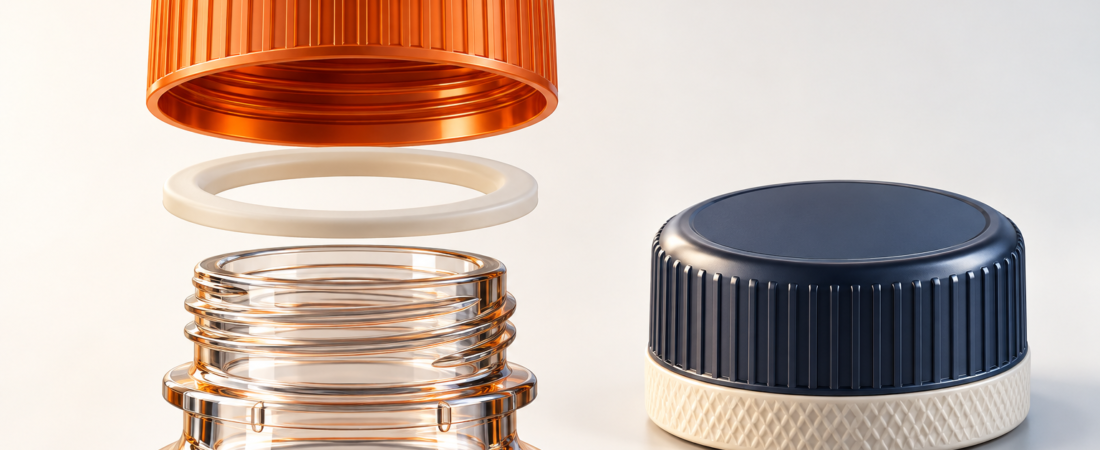
AI concept illustration of alternative component arrangements. It is not an approved assembly, tested seal or evidence of Mincong multi-material production.
For a closure that already works with a separately assembled seal, integration needs a defined benefit. For a design that cannot retain or position its soft component reliably, an integrated route may deserve investigation. Neither choice is automatically simpler once tooling, equipment and validation are included.
Separate the three production routes
| Route | What it involves | Main question to resolve |
|---|---|---|
| Separate moulding and assembly | Components are produced independently and brought together | Can the seal be located, retained and inspected reliably at the required output? |
| Overmoulding onto a substrate | A second material is moulded onto an existing component | Are positioning, material compatibility and retention adequate for the actual use? |
| Integrated multi-component moulding | Equipment and tooling deliver and position different materials within the planned process | Can the complete system meet the required sequence, quality and maintenance needs? |
These categories describe different production arrangements. A conventional single-material family mould does not become a two-material process because it makes two components. See the cap-and-plug family-mould article for that separate balance and production-ratio decision.
Ask whether bonding is required, or retention is enough
Identify whether the soft feature must chemically bond to the rigid substrate, remain mechanically captured, or be replaceable. Protolabs' overmoulding guidance distinguishes material compatibility from mechanical retention. A broad label such as PP plus TPE is not a qualification of every pair of grades.
Request the actual grade pairing and supplier guidance. Where relevant, compare adhesion, retention and the ability to maintain the intended seal after the agreed exposures and use cycles. Mechanical features need their own review: a retention undercut can affect mould release, local stress and the assembly route. Do not add a difficult lock simply because adhesion has not been established.
Test the sealing job separately from the material joint
A well-attached soft feature can still form an unsuitable bottle seal. Define the mating surface, compression or contact geometry and the required opening behaviour. Use the actual bottle or reference component and the agreed conditioning and package tests.
For a dispensing valve, add the intended product, use orientation and dispensing action to the evaluation. Valve formulation and manufacture are specialised responsibilities; they should not disappear into a general quotation for a rigid cap mould. Keep product-contact suitability with the responsible material and packaging owners.
Compare complete equipment and service requirements
ARBURG describes multi-component processes using different injection and movement arrangements. The practical purchasing implication is to specify the proposed equipment, transfer or indexing method and control responsibility rather than assuming an ordinary single-injection machine can run the tool.
Compare the alternatives through accepted assemblies. Separate components introduce storage and assembly work; an integrated process introduces its own tooling, material and sequencing dependencies. Ask how a rejected soft feature affects the rigid component, how a material change will be qualified and what stops when one part of the system needs service. No single route removes every source of downtime.
Select the route around the project, then confirm supply scope
For an established rigid cap with an obtainable, validated seal, separate moulding and controlled assembly may be the practical starting point. Where integration addresses a documented positioning or handling problem, develop the material pairing and production concept before committing to tooling. Treat either conclusion as project-specific rather than a general preference for more complex machinery.
Mincong's oil and functional closure mould range provides a starting point for the rigid-tooling discussion. This article does not claim ownership of a multi-component machine or confirmed supply of 2K moulds, elastomer valves or integrated production systems. Any additional scope requires explicit technical and supplier confirmation.
Send the component assembly and material requirements for review, stating which parts are to be moulded, purchased and assembled, and who owns the final package test.
Technical references and scope
References checked on 2 November 2026. Supplier documents describe their own materials or equipment. Project review and acceptance proposals above need confirmation for the actual product, material and production system.