A family mould produces different components in one tool. For a cap and plug, that can appear attractive because both parts leave the machine together. It is a useful option only when the components can share a viable moulding condition, production ratio and handling route. Separate tools may give a better result even when the initial tooling arrangement looks less compact.
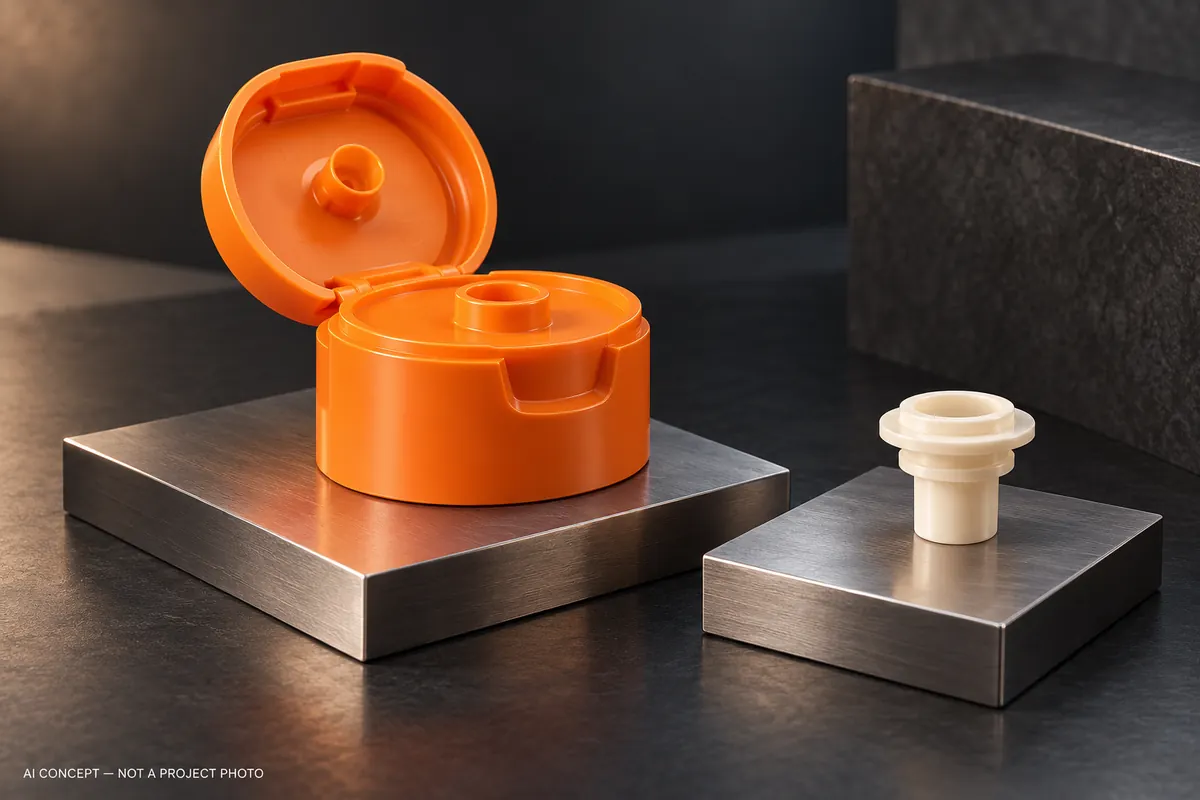
Check whether the parts can share one material and shot
Identify each component's exact resin and colour requirements. A conventional single-material family mould cannot independently deliver two different resins into the same shot. If the closure needs different materials or colours, establish whether separate moulding or an explicitly engineered multi-material system is being proposed.
Do not treat a liner, flexible plug and rigid shell as interchangeable material applications. Their jobs can differ. First resolve the approved component specification; then decide whether joint production remains a realistic option. Otherwise, apparent tooling savings may depend on changing the closure without a validated reason.
Compare the filling and packing needs
The larger component is not necessarily the only difficult one to fill. Thin paths, local restrictions and gate positions can cause components to fill at different times. A shared setting may leave one part incomplete while the other is overpacked.
Review the runner and gate proposal with the geometry and material. Simulation can support comparison where included, but it must use the relevant inputs and be checked against trial evidence. Do not promise balanced filling solely because the layout looks symmetrical or the components have similar weights.
Let cooling and release influence the decision
One component may need more time before it can be removed without damage. In a shared mould, that requirement can influence the common cycle. Separate tools may allow each part to use an appropriate production condition, although they introduce their own machine scheduling and handling requirements.
Review release motions and support for both parts. An apparently simple plug can still have engagement features that need controlled removal. The mould must deliver usable components without damaging a sealing surface merely to keep both parts on one cycle.
Calculate the ratio from accepted parts
If an assembly needs one shell and one plug, the nominal mould ratio is only a starting point. Rejects, inspection and interruptions may create unequal available quantities. Define how the parts will be counted, separated, stored and presented to assembly.
For example, a hypothetical tool producing equal numbers of shells and plugs does not guarantee equal accepted quantities after a component-specific rejection. That is an illustration of inventory risk, not a forecast for a Mincong project. The production plan should explain how any imbalance will be handled without concealing it in a theoretical output figure.
Include downtime and future changes
Ask what happens when one component needs service or a design revision. Can production continue in an approved way, or must the whole tool stop? Do not assume that shutting off a cavity is permitted; any operating mode needs engineering confirmation.
Separate tooling can make it easier to change one component independently. A family mould may still be appropriate when the parts and production programme remain closely matched. Compare those options against expected order patterns, service capability and the cost of unused component stock.
Ask for two defined proposals when the choice is uncertain
Request a family-mould proposal and a separate-tool proposal on the same component and acceptance basis. Compare included tooling, machines, auxiliaries, assembly support and service parts. A price per cavity alone cannot express the difference between the alternatives.
For an oil or functional closure project, send the complete assembly and individual parts, resin grades, required ratios and machine data. The review should identify the preferred production route and the assumptions that could change it. This is a configuration decision, not a claim that every two-piece closure should be made in one mould.
Continue the project review
Oil and functional closure moulds · Edible oil cap moulds · Same-part cavity balance
Send drawings or samples for a mould review →
Technical references and scope
General application and engineering references checked on 30 October 2026. These do not establish Mincong project performance or transfer another supplier’s design, certification or claims.