ENGINEERING NOTES
A mould can sweat when a cold surface is exposed to air whose dew point is higher than that surface temperature. The solution is to change that relationship: either raise the relevant surface temperature within an acceptable process window or reduce the moisture in the air reaching it. First separate condensation from a water leak, because dry-air equipment will not repair a leaking connection.
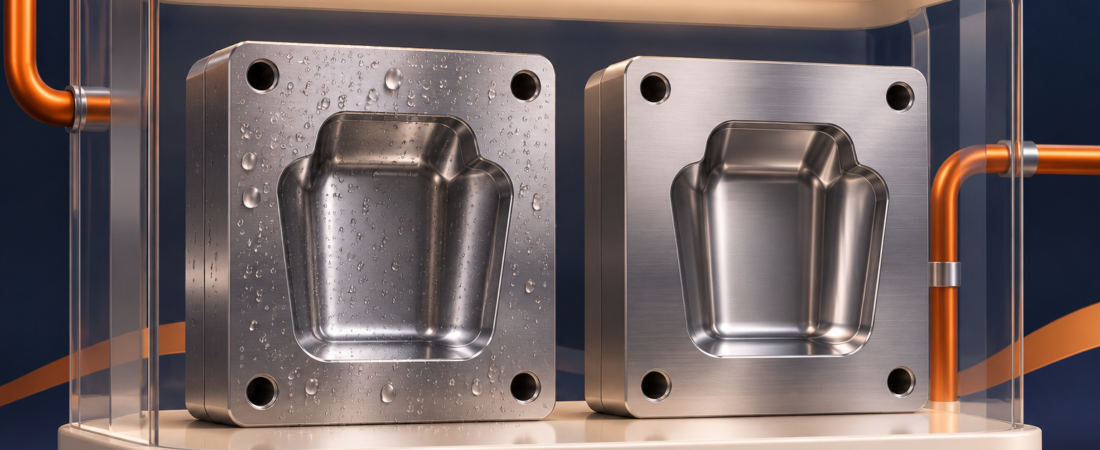
AI concept illustration. Wet and dry inserts form a visual comparison, not a measured enclosure test or an installation design.
Find whether the water is entering or forming locally
Inspect the pattern using the site's safe maintenance procedure. Water starting at a hose, fitting or damaged seal points to a different corrective route from droplets forming across cold exposed surfaces as ambient conditions change. If the source is uncertain, have the cooling system and local environment assessed before adding equipment.
Repair an established leak and verify the repair under the intended operating conditions. Wiping the surface or spraying it with air may temporarily hide water while leaving the fault active. Keep electrical areas and product-handling surfaces within the plant's safety and quality procedures.
Compare local dew point with the cold surface
Measure air conditions close to the mould, including periods when humid air enters the area. Compare the resulting dew point with relevant cold surfaces, not only a distant room thermometer. Cooling-water temperature is useful system information, but it is not always the same as the exposed steel surface temperature.
For illustration only, a local dew point of 22°C and a surface at 15°C indicate condensation risk. These are assumed values, not measurements from Mincong or operating targets. The actual control margin should account for local variation and measurement uncertainty; a single afternoon reading does not describe the whole production week.
Raise cooling temperature only if the product permits it
Where the process has room for a warmer mould, trial a controlled cooling-temperature adjustment and verify the resulting part. Check dimensions, release and cycle consequences rather than accepting a dry tool alone as success. A slower or distorted closure is not an adequate trade for eliminating droplets.
For PET preforms, include clarity and removal condition in that assessment. For caps, include fit and the intended closing behaviour. If the required cold condition cannot be relaxed without unacceptable results, investigate air-moisture control instead of repeatedly changing an already qualified process.
Use dry air where the cold condition must remain
Shini's mould-sweat discussion describes reducing the dew point of air around the mould and distinguishes open and enclosed approaches. For a proposed local solution, ask the equipment supplier to assess coverage and incoming humid-air load at the actual mould, not only its machine-room rating.
Review how door openings, takeout movements and gaps affect the treated area. An enclosure also needs acceptable access and must preserve guarding and machine functions. Define who supplies and maintains the system. This is an equipment-integration review, not a claim that Mincong supplies a particular dehumidifier.
Keep three different moisture problems separate
| Problem | Corrective focus |
|---|---|
| Liquid escaping from the cooling system | Repair the leak and verify the circuit |
| Ambient vapour condensing on cold steel | Control the local dew-point/surface-temperature relationship |
| Moisture carried within hygroscopic resin | Restore the material's specified drying and transfer route |
A resin dryer and a mould-sweat solution serve different locations. Adding drying capacity for PET pellets does not establish that the air around the tool is dry enough, and dry air around the tool does not qualify resin moisture. Use the PET drying article for the material route and cooling-design guide for circuit performance.
Accept the solution through changing conditions
Verify that the intended surfaces remain dry through representative ambient and production conditions, including the relevant authorised startup. Confirm part quality and accepted output at the same time. Include the routine checks and upkeep that keep the chosen solution effective.
Compare the alternatives honestly: a warmer process may consume cycle capacity, while local dry air adds equipment, energy and maintenance. There is no universal lowest-cost choice without the actual operating range. For PET preform tooling or cap moulds, send the cooling and environmental conditions for review with the affected-surface photographs.
Technical references and scope
References checked on 4 November 2026. Supplier documents describe their own materials or equipment. Project review and acceptance proposals above need confirmation for the actual product, material and production system.