Dual-Flap Seasoning Cap Moulds for Shaker and Pour Openings
Mincong Mould reviews injection moulds for seasoning closures with two independently opening flaps: one access route for shaking and another for pouring. The tooling proposal should define both openings, both hinges and the closed condition of each lid. A dual-flap cap needs its own filling, release and closing review rather than a second lid added to a single-flap quotation.
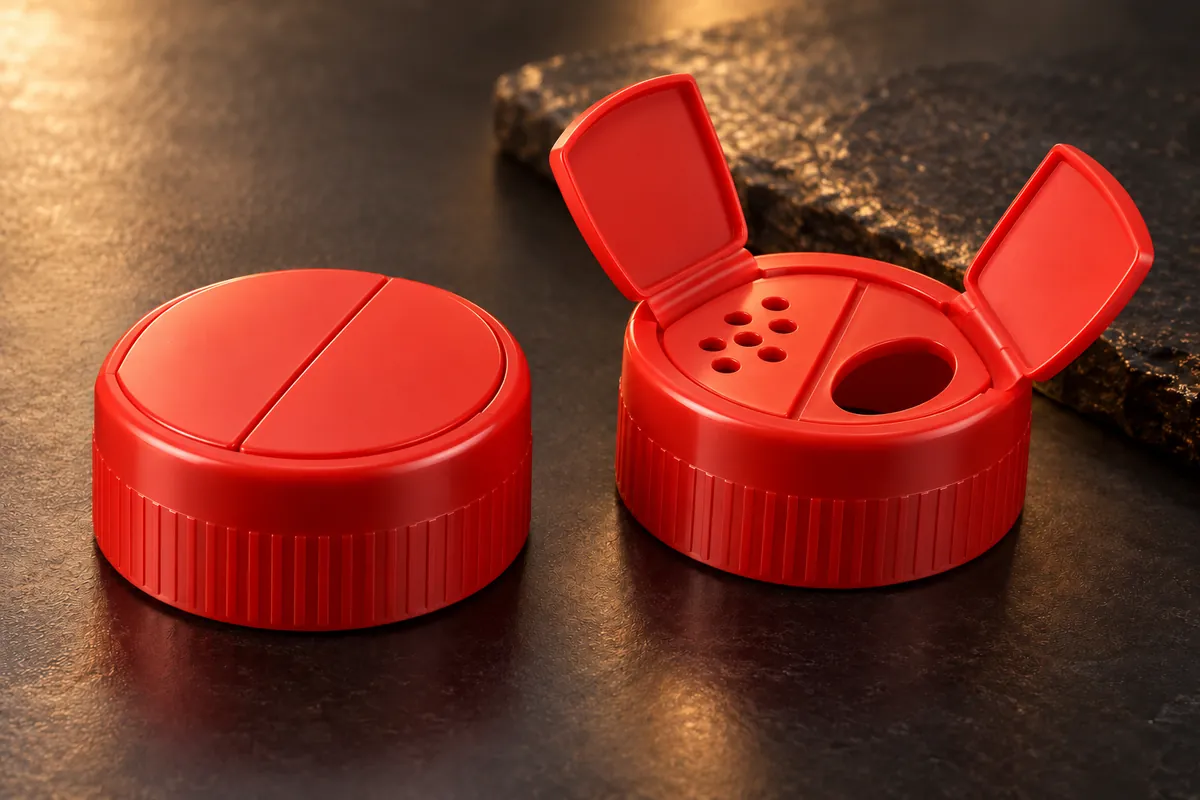
Define what each opening must deliver
Provide the closure and container drawings or approved samples, together with the intended dry product. Identify the shaker-hole pattern, pouring opening and any surfaces that must remain free of flash. Particle size, product flow and the desired dispensing behaviour belong in the packaging specification; moulded hole dimensions alone do not establish a controlled serving quantity.
Clarify whether the dispensing deck and two lids form one moulded component. If the design uses separate pieces, a liner or an insert, list those components and their assembly responsibilities. The quoted mould package must match that construction.
Make two reliable hinges and two separate latches
For an integrated PP design, the review must consider how the selected grade reaches each hinge and how the open lids are supported during release. The two hinges may experience different flow conditions. Approving the feel of one lid does not approve the other.
Specify the required opening positions, closing engagement and permitted witness marks. Trial samples should demonstrate each flap independently and both flaps together. Include the intended liner or other sealing component when relevant; a lid that stays shut is not by itself evidence of moisture-barrier performance.
Form the dispensing details without creating a maintenance trap
Small hole-forming features, the deck edge and latch contacts need defined inspection access and a repair route. Agree which features can be replaced and how a repaired insert will preserve the opening pattern and lid fit. Simply polishing a tight opening can alter dispensing and closing behaviour.
The gate and parting arrangement should protect the functional deck while allowing practical release. Check vent access without allowing flash into the openings. Final gate, steel and ejection details follow the approved geometry and material rather than a standard cavity-count package.
Select the closing sequence around both lids
If caps must leave production closed, identify whether closing happens in the mould or downstream. Review contact positions, clearance and the order of the two lid movements. One closing motion must not obstruct the second lid or force it through an unsupported hinge position.
Our published pepper-cap project describes a separate in-mould closing application with a YUDO runner. It provides context for discussing closing integration, not proof that its mechanism, cavity count or cycle transfers to this dual-flap design. A proposed runner and closing device must be evaluated as separate systems.
Agree an acceptance sample, not only an attractive cap
Check cavity-identified parts for hole and pour-opening condition, hinge movement, latch engagement, container fit and the specified appearance after conditioning. Evaluate dispensing with the intended dry product, including both dispensing modes. Any barrier, food-contact or distribution requirement needs its own agreed evidence.
Send the component files or samples, container neck, approved resin grade, dispensing requirements and required closed state. Include available machine and handling information. These inputs allow us to define the tooling and closing scope without treating an illustration or a familiar neck designation as the finished specification.
Related engineering resources
- Flip Top Cap Mould
- Living Hinge Design for PP Flip-Top Caps: What to Confirm Before Tooling
- What to Check in an Automatic Closing Flip-top Mould Trial
- 12-Cavity PP Pepper Cap Mould with In-Mould Closing
Explore related mould projects
Swipe or use the controls to explore 3 related product pages.


Technical references and scope
Supplier examples describe their own products. They do not establish Mincong certification, supplier affiliation or a validated project result. Proposed checks must be agreed for the specific component, resin and production equipment.