When a cap is heavy, difficult to release or inconsistent in fit, increasing pressure is not a reliable universal fix. First establish whether the problem originates during filling, subsequent packing or removal. Then adjust the relevant stage with the approved material and a controlled comparison. The aim is a stable functional cap, not simply a fuller-looking sample.
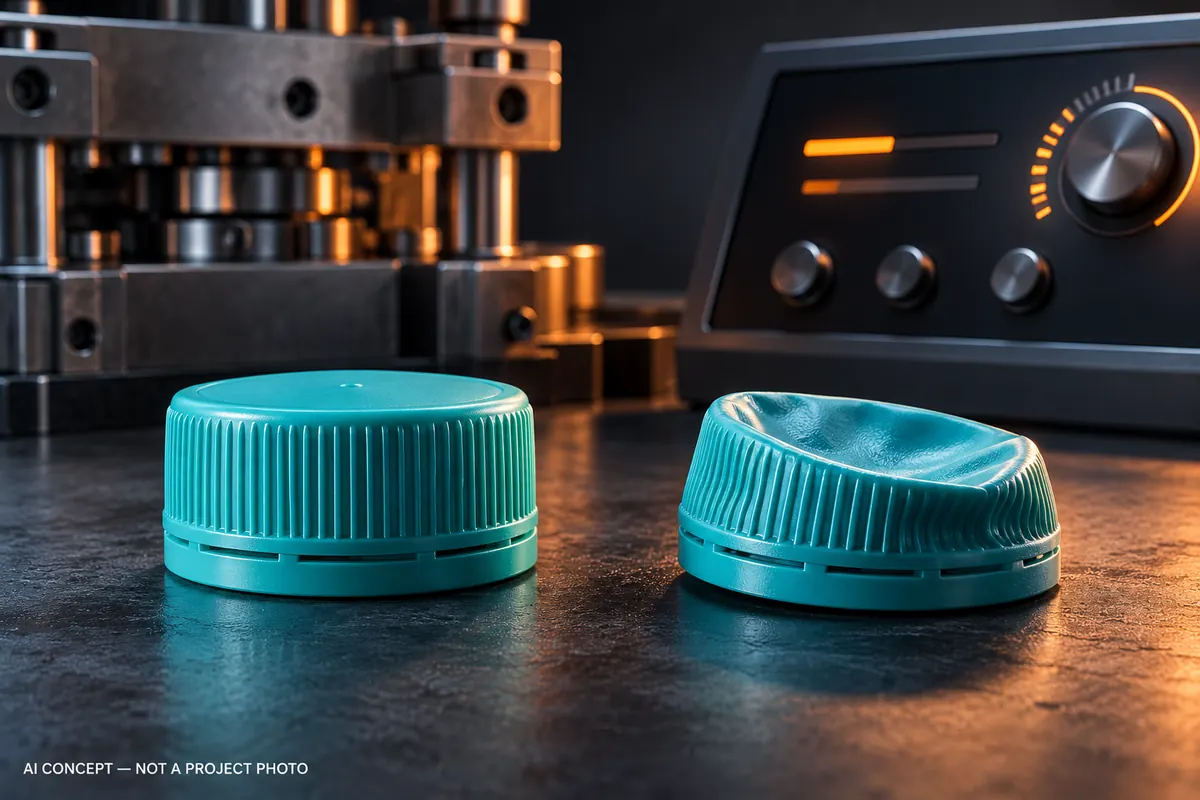
Establish what the machine calls packing and holding
Machine interfaces and production reports do not always use these labels in the same way. Identify the velocity-to-pressure transfer and the pressure-controlled stages that follow it. Record whether displayed pressure is a hydraulic, plastic or other defined value before comparing settings across machines.
Packing compensates for material contraction while the feed path remains effective. Extending pressure application is not the same as extending useful packing. The relevant duration depends on the actual gate and material condition, and on the selected runner system. Do not copy a percentage or time from another closure.
Resolve a filling problem before extending the hold
Inspect the feature that is incomplete or inconsistent and relate it to the filling sequence. Check material delivery, restrictions, air escape and the actual transfer behaviour. A cap that cannot be filled properly should not be accepted merely because more pressure later masks part of the symptom.
If the same cavity or branch behaves differently, investigate the local cause. A global pressure increase can improve one area while worsening another. Keep cavity identity so a process adjustment does not conceal an unresolved feed or thermal imbalance.
Use a controlled duration comparison
Where appropriate and safely established by the process engineer, compare holding duration while keeping the other relevant conditions stable. Track part mass together with the critical dimensions, appearance and release behaviour after a defined conditioning interval. Establish whether additional duration still changes the moulded result.
A mass plateau can be useful evidence in a suitable study, but it is not alone proof of correct seal performance or a complete process window. Hot-runner operation and any valve timing need to be interpreted with the installed configuration. Confirm how the feed path is actually controlled before drawing a gate-freeze conclusion.
Reduce excessive packing without accepting a new defect
If the evidence indicates overpacking, evaluate an appropriate pressure level or staged profile with the responsible process engineer. Compare the functional regions, not only total weight. A reduction that eases ejection but loses thread engagement or seal fit is not a successful correction.
Autodesk describes packing profiles as a way to manage volumetric shrinkage and avoid overpacking. That is a reason to evaluate the profile, not a prescription for a universal descending curve. Each stage should have a purpose supported by the actual moulded response.
Keep cooling and release in the comparison
An apparently improved pressure setting can still leave the part too soft for removal. Check the thermal and release conditions before attributing deformation entirely to holding pressure. Conversely, extra cooling cannot be assumed to cure every stress or dimensional problem caused earlier in the shot.
Compare parts under a consistent sampling and conditioning method. Include opening or assembly tests that matter to the cap. A production setting should remain interpretable after a restart or material change rather than depending on one unusually good shot.
Agree on the evidence before changing steel
Record the actual material, machine, stage definitions, cavity samples and accepted limits. If the available process range cannot deliver a compliant cap, use that evidence to review the gate, cooling, geometry or release route. Do not start a tool correction from an unexplained pressure number.
For a cap-mould review, send the affected feature, the approved bottle interface and a concise trial comparison. Mincong can review the tooling question within the agreed scope; final operating conditions require the responsible production team and the actual equipment. No generic pressure setting is supplied as a safety or quality guarantee.
Continue the project review
Water cap moulds · Pressure values and calculation · Short-shot investigation · Cap warpage solutions
Send drawings or samples for a mould review →
Technical references and scope
General application and engineering references checked on 30 October 2026. These do not establish Mincong project performance or transfer another supplier’s design, certification or claims.