MEDICAL PACKAGING MOULD
Medical Consumable Moulds for Tubes, Tips and Closures
Custom injection moulds for centrifuge tubes, pipette tips, collection tubes and medical packaging caps. Part drawings, resin, critical dimensions, cavity layout, ejection and your validation requirements guide each tooling proposal. Explore our Blood Collection Tube Moulds and Syringe Barrel Moulds for component-specific tooling.
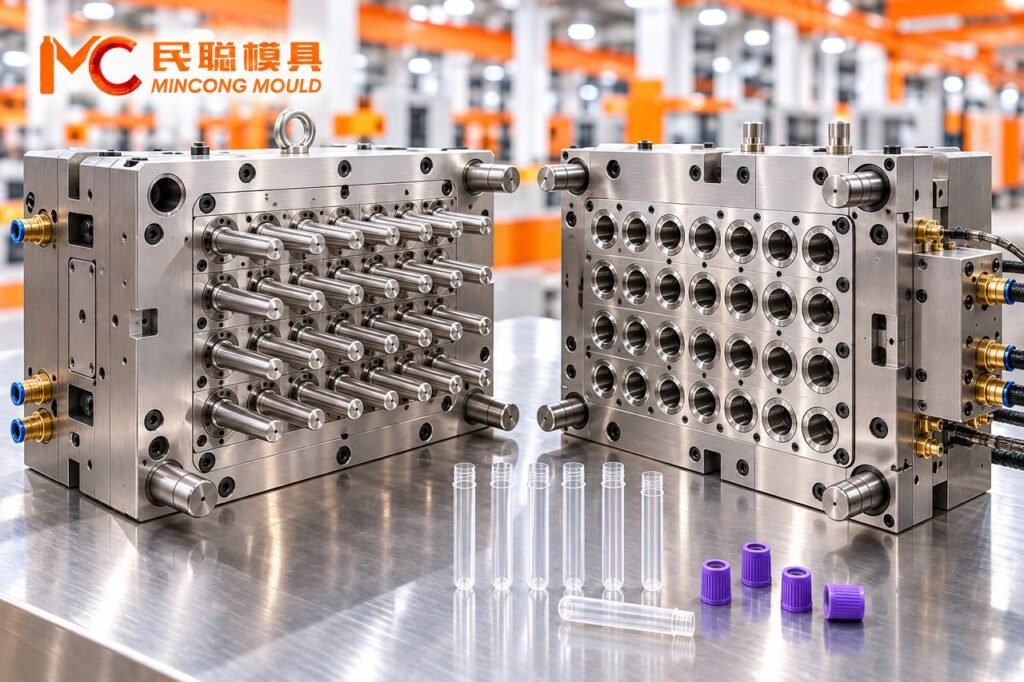
What Matters in Medical Packaging Mould Design?
Tube walls, pipette-tip geometry and cap sealing faces involve different critical dimensions. The approved part specification should identify what will be measured, how the part will be handled and which features need consistency across cavities. For an uneven tubular wall, separate fixed alignment faults from filling-load effects in the core-shift correction review.
Part Geometry
Threads, sealing faces, thin walls and small internal features need tooling choices matched to the actual part.
Cavity Consistency
Flow, cooling and ejection must be evaluated across all cavities for repeatable parts.
Material Compatibility
Steel, surface finish and runner options depend on the specified resin and production environment.
Medical Packaging Mould Configuration
The number of cavities, runner, steel, finish and ejection arrangement follow the component drawing, specified resin, inspection criteria and available injection machine.
| Products | Centrifuge tubes, pipette tips, collection tubes, medicine caps and project-specific parts |
| Resin | Defined by the customer’s part specification |
| Cavity Count | Selected around part size, output target and machine limits |
| Runner | Hot or cold runner according to project requirements |
| Steel and Finish | Selected for the resin, geometry and maintenance plan |
| Ejection | Designed around wall thickness, draft and part handling |
Medical Consumable Mould Examples

Pipette tip mould

From Drawing to Production Trial
The customer’s drawings, resin grade and acceptance criteria define the tooling review. We agree on gating, cooling, ejection and inspection points before machining, then review trial parts against those criteria. Product validation and regulatory approval are separate customer-defined steps.
- Confirm part drawing, neck or mating component and key dimensions.
- Review resin, shrinkage, filling, venting and cooling.
- Plan cavity layout, ejection and maintenance access.
- Evaluate samples against the customer’s acceptance criteria.
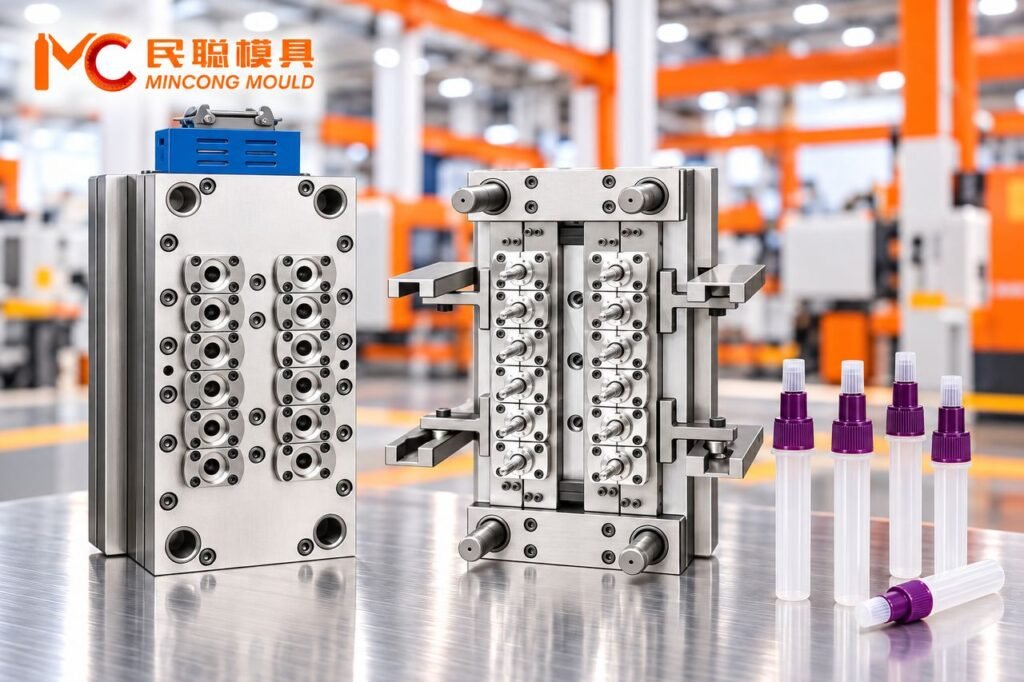
Typical Medical and Laboratory Components
Centrifuge tubes, collection tubes, pipette tips and medicine packaging caps need different release and inspection plans. Each proposal follows the actual part and its production conditions.
Tubes and Containers
Centrifuge, sample and Blood Collection Tube Moulds.
Caps and Closures
Medicine bottle caps and other packaging closures.
Precision Consumables
Pipette tips and small laboratory plastic parts.
Small Tube Mould and Samples
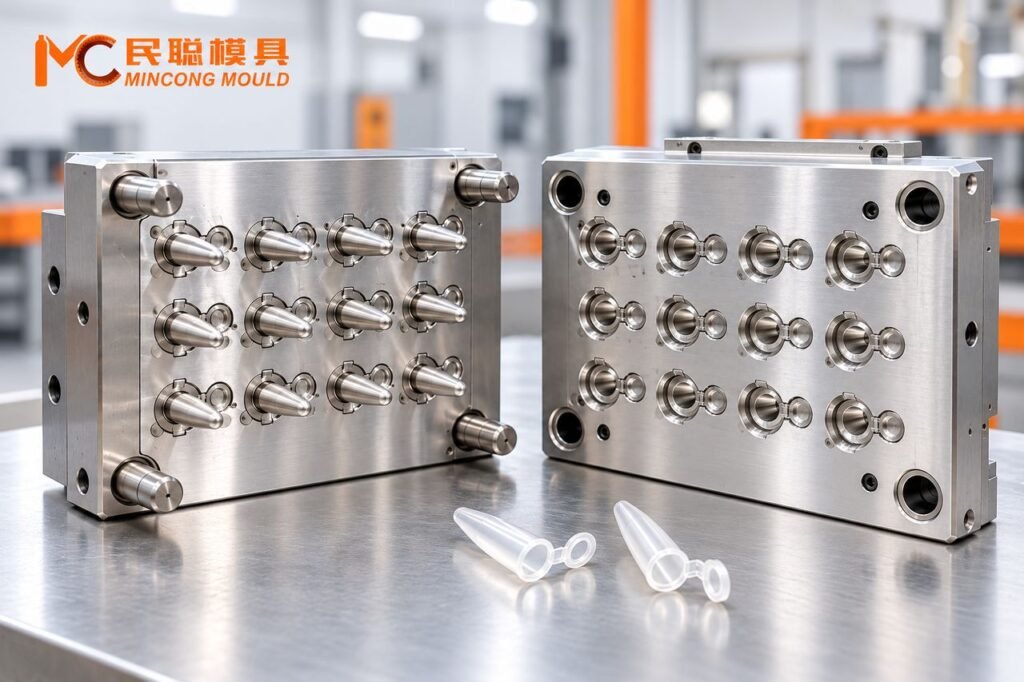
Microcentrifuge tube mould
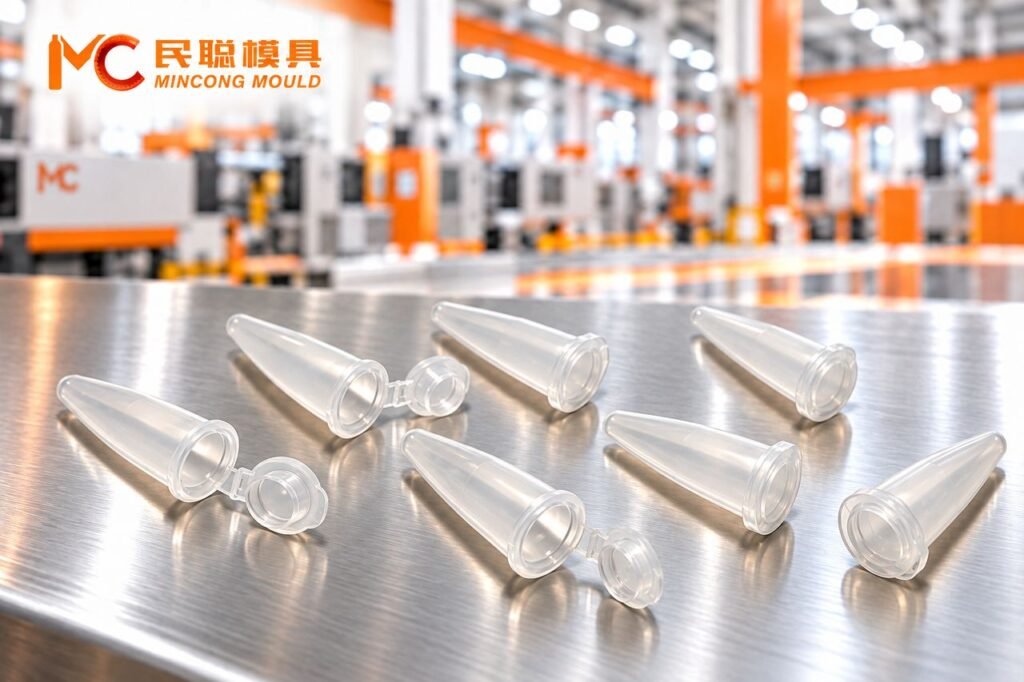
Hinged-cap tube samples
What to Send for a Medical Consumable Mould Quote
For a medical packaging or syringe component mould, provide the part drawing, resin grade, critical dimensions, machine data and sample acceptance criteria. These inputs define the tooling and inspection scope. Identify any production-environment or validation requirements at the quotation stage. Submit your medical mould project requirements.
- 2D/3D part drawings and critical dimensions
- Resin grade and intended production environment
- Target output and preferred cavity count
- Injection machine specifications and sample acceptance criteria
Medical Packaging Mould FAQs
Can you design to our existing injection machine?
Yes. Share the machine’s clamping force, shot capacity, tie-bar spacing and other relevant limits for evaluation.
How is the cavity count chosen?
It depends on part geometry, cycle target, projected demand and machine capacity. We review these together before specifying a layout.
Do you provide medical certification for the finished product?
Product validation, regulatory status and cleanliness requirements must be defined and approved by the customer. The mould proposal is based on those requirements.
Medical component mould videos
Selected videos from our project archive. Each clip relates to its own tooling or product example. Select Play to load the YouTube player.
Measuring cup mould
Archive video from Mincong Mould’s YouTube channel.
Watch on YouTube ↗Syringe mould trial & product inspection
Archive video from Mincong Mould’s YouTube channel.
Watch on YouTube ↗PRODUCT SHOWCASE
Explore Medical Mould Products
Choose a component to explore its tooling scope, design considerations and quotation requirements.
 Concept illustration
MEDICINE BOTTLE CLOSURES
Medicine Bottle Cap Moulds
Review the bottle interface, seal or liner and required opening features.
Explore product →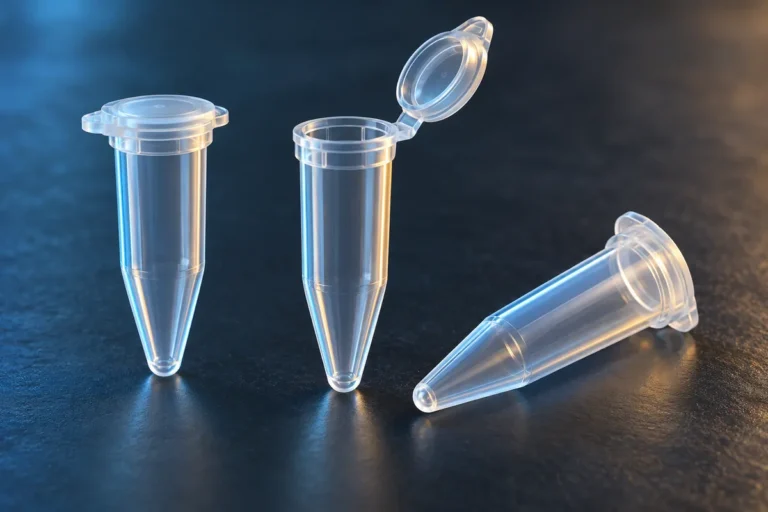 Concept illustration
LABORATORY TUBE TOOLING
Microcentrifuge Tube Moulds
Review tube wall balance, the hinged lid, seal and release around the component specification.
Explore product → Concept illustration
LABORATORY COMPONENT TOOLING
Pipette Tip Moulds
Review tip fit, open outlets, release and agreed functional acceptance.
Explore product → Concept illustration
MEASURING CUP TOOLING
Medicine Measuring Cup Moulds
Review graduations, rim geometry, stacking and defined component acceptance before tooling.
Explore product → Concept illustration
TUBE-BODY TOOLING
Blood Collection Tube Moulds
Review tube walls, closure interfaces, cooling and release around your approved component specification.
Explore product →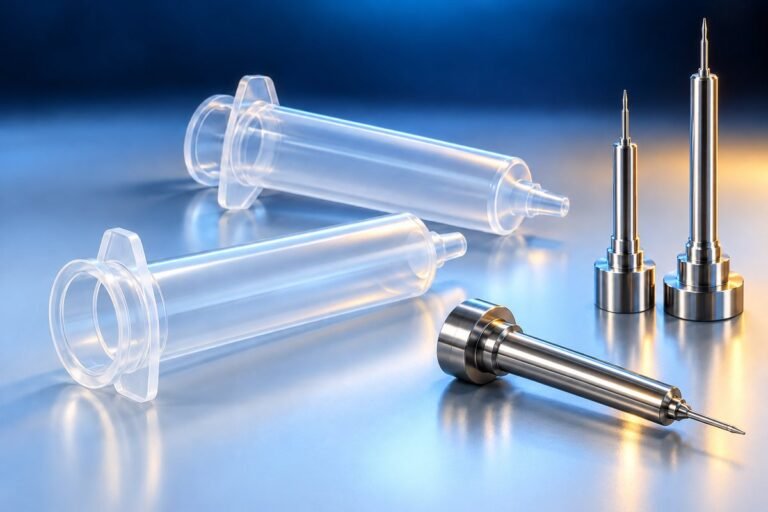 Concept illustration
SYRINGE COMPONENT TOOLING
Syringe Barrel Moulds
Plan the barrel bore, mating interfaces and release conditions against the defined drawing and inspection criteria.
Explore product →Images are AI-generated concept illustrations, not project photographs. See each product page for its scope and project-specific requirements.
Discuss a Medical Packaging Mould Project
Share your component drawing and production criteria to start a technical review.