Microcentrifuge Tube Moulds for Wall Balance, Hinge and Seal Requirements
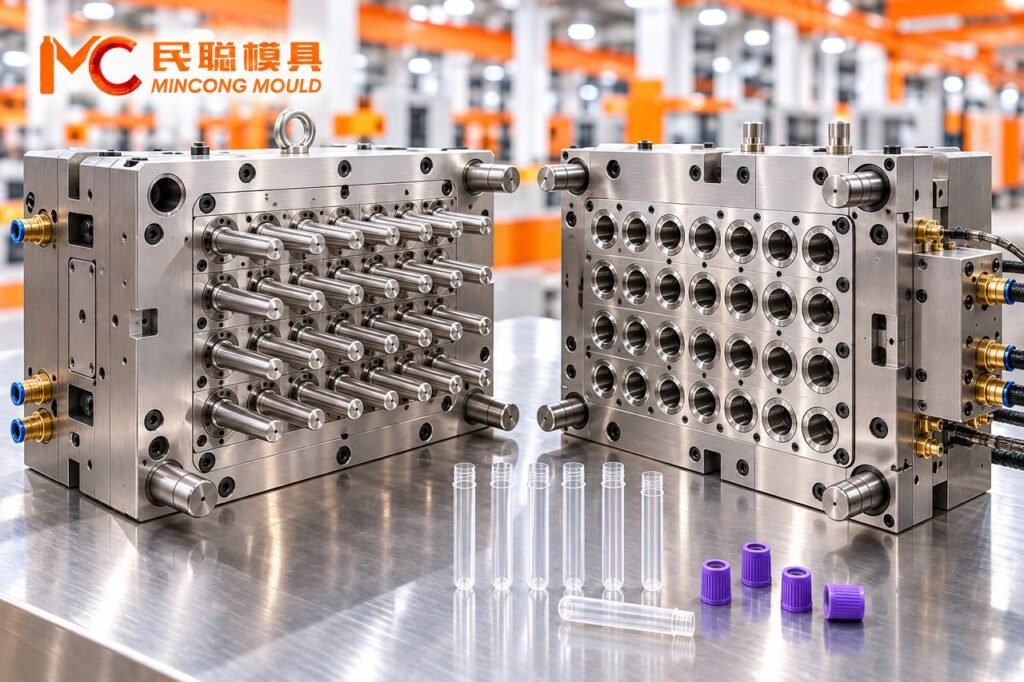
Mincong Mould reviews custom injection moulds for microcentrifuge tubes with a defined tube body, closed base and lid construction. Wall balance, core support, hinge formation and the sealing contact need to be considered together. Tooling acceptance is separate from proving the finished tube's centrifugation rating, cleanliness or suitability for a laboratory protocol.

Define the tube and lid as one component system
Provide the complete part drawing and approved samples, including the conical base, rim, attached hinge and lid if they are integrated. Specify the open moulding position and required position at collection. A tube-body quotation must not silently exclude the lid geometry or a separate closure component.
Identify the application requirements the customer will evaluate. These may involve fit, closure retention, handling or defined liquid-containment tests. The relevant rotor or support conditions belong in any centrifugation evaluation; a nominal volume or a familiar tube appearance does not establish a force rating.
Support the core while preserving the closed base
The core and cavity must form the required internal space without leaving an unintended opening at the conical end. Review alignment, support, filling loads and the approved base thickness. Long core geometry can make local wall consistency as important as the average part weight.
Agree how the wall will be inspected at named axial and circumferential positions. If one side is thin and the opposite side is thick, investigate alignment or pressure-driven core movement before accepting a heavier overall shot as the solution. A sample can reach its target mass while retaining an unacceptable thin region.
Make the lid seal without overloading the hinge
For a one-piece hinged construction, review the material grade, flow into the hinge and the route used to move the lid into its intended position. Protect the hinge and sealing contact during release and collection. A pronounced snap is not an independent measure of liquid containment.
Define the closure check with the packaging owner: what is assembled, how it is closed, the conditioning and the test conditions. Opening effort, retention, containment and repeated lid operation may need different acceptance methods. Do not replace them with a visual judgement that the lid appears closed.
Coordinate cooling, release and handling
Compare the cooling and release proposal with the slender body and attached lid. The part must be supported at suitable surfaces rather than pulled through a critical seal or distorted at the warm rim. The required take-out orientation and any downstream rack, inspection or bagging interface should be clear before the layout is fixed.
Discuss wear and maintenance access around the base, rim and hinge-forming areas. If inserts are replaceable, their locating surfaces and fit must preserve the approved tube geometry after service. Replaceability does not make every replacement part automatically interchangeable.
Separate tooling evidence from laboratory product claims
PP is a common microtube material, but the specified grade and additives require approval for the intended use. Purity, sterilisation, chemical exposure and temperature claims need evidence for the finished product and process. This page does not claim those properties from the resin family or from a mould photograph.
Send the complete component drawing, resin specification, lid and seal requirements, handling plan and proposed acceptance tests. Include equipment and output information already available. The review can then address a defined microtube tool and trial plan rather than borrowing another brand's centrifugation, purity or lifetime claims.
Related engineering resources
- Medical Packaging Mould
- Blood Collection Tube Moulds for Defined Tube and Closure Interfaces
- Pipette Tip Moulds for Defined Fit, Outlet and Release Requirements
- Plastic Injection Molding Tolerances: Agreeing Cap Inspection Before Tool Approval
Explore related mould projects
Swipe or use the controls to explore 3 related product pages.


Technical references and scope
- Eppendorf — microcentrifuge tube application and variant-specific properties
- Autodesk Moldflow — core shift mechanisms and simulation limits
Supplier examples describe their own products. They do not establish Mincong certification, supplier affiliation or a validated project result. Proposed checks must be agreed for the specific component, resin and production equipment.