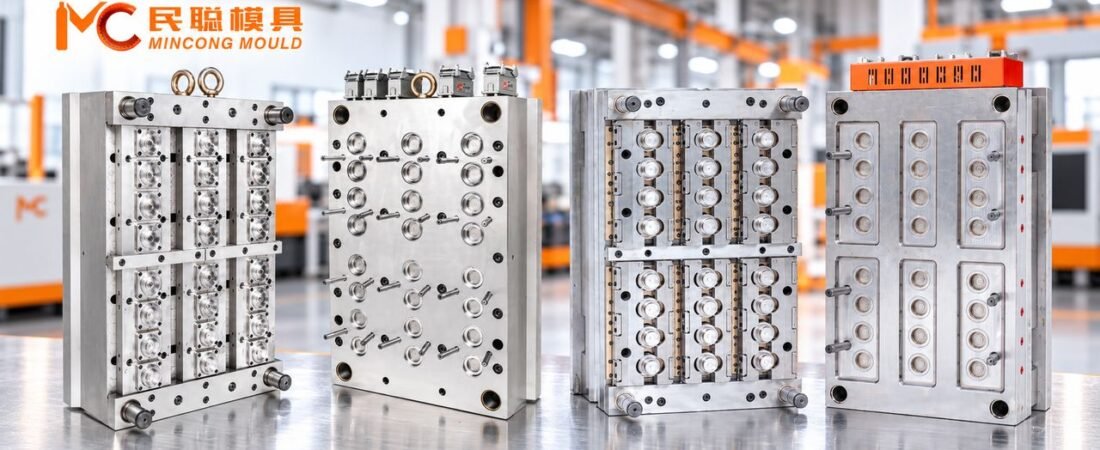
In injection molding, the sprue, runner and gate have different jobs in delivering molten plastic to the mould cavity. For a cap mould buyer, understanding these terms helps make the supplier’s proposal more concrete: where will the plastic enter the cap, what mark will remain and how will the moulded parts be separated from any solidified feed system?
Start with the proposed flow path, then agree the appearance and handling requirements. The name of the runner system alone does not settle those questions.
1. Distinguish the sprue, runner and gate
The table below describes the terms using a conventional cold-runner arrangement as the starting point.
| Term | Role in the flow path | What a buyer should ask |
|---|---|---|
| Sprue | The main inlet passage receiving melt from the injection-machine nozzle. The word can also refer to the plastic that solidifies in this passage. | Which inlet arrangement is proposed, and what solidified feed material leaves the mould? |
| Runner | A distribution passage carrying melt towards one or more cavity gates. | How will material reach the cavities, and how will any solidified runners be handled? |
| Gate | The opening through which melt enters the part-forming cavity. | Where is the entry point on the cap, and what gate mark is acceptable? |
Conceptual cold-runner flow path only. This is not a mould drawing, and the arrangement is not a recommendation for a particular cap.
A gate is therefore not another name for the complete runner system. When reviewing a cap sample, the small mark at the entry location is a gate vestige; it does not reveal the complete melt-delivery layout behind it.
2. Ask the supplier to identify the actual arrangement
The diagram is a teaching example, not a layout shared by every mould. In a cold-runner arrangement, feed passages cool and leave solidified material to be separated from the parts. A hot-runner arrangement keeps its melt-delivery passages heated and can feed gates without the same cold-runner network being ejected each cycle.
Ask the supplier to identify any cold sections that remain in the proposed configuration. Also confirm the proposed gate method. “Hot runner” alone does not tell you the gate location or the appearance of the finished cap.
When discussing a YUDO proposal or a Husky alternative, request the specific nozzle and gate arrangement, resin application, actuation and control requirements, maintenance access and local service scope. Compare those details with the cap requirement. A brand name does not define the gate configuration or establish an acceptance result; use of Husky in a particular Mincong project requires a separate integration confirmation.
For the wider production and investment comparison, see our hot-runner versus cold-runner cap mould guide.
3. Mark gate-location restrictions on the cap drawing
Review the proposed gate point on the product drawing before tooling approval. Identify the surfaces where appearance matters, together with features that must mate, seal, open or close.
For a cap, these may include a decorated top surface, a sealing lip, a dispensing opening or a flip-top hinge area. They are review priorities, not a universal list of prohibited gate locations. Ask the mould designer to explain how the proposed position works with the geometry and resin.
For example, if the top panel will be printed, provide the intended artwork area. Agree whether the gate location or remaining mark could interfere with that operation. For mating and sealing requirements, use the approved cap-and-neck information described in our bottle cap mould design guide.
4. Agree a gate-vestige acceptance record
A gate vestige is the remaining mark at the point where plastic entered the cavity. For a cap buyer, the useful question is what is acceptable on the finished closure, under a defined inspection method.
“Small gate mark” leaves too much room for interpretation. Separate the shape of the mark from its surrounding appearance and from its effect on the application.

Separate three acceptance questions
| Question | What to agree before the trial |
|---|---|
| What remains at the entry point? | Identify whether the requirement concerns a projection, recess or other local profile. Define its reference surface and any required dimensional limit on the approved drawing. |
| How should the surrounding surface look? | Agree the viewing conditions and comparison sample for appearance. Record gate blush or other nearby surface changes separately from the residual profile. |
| Could it interfere with the application? | Identify any printing, labelling, stacking, assembly or handling requirement affected by this particular location. Test the relevant operation where needed. |
These are proposed review categories, not a universal inspection standard. A cap can meet one requirement while missing another. For example, a local mark may meet the agreed profile limit while the surrounding appearance still fails the approved visual requirement. This is an illustrative acceptance scenario, not a reported Mincong case.
For a surrounding halo or surface change, use our gate blush trial-check guide. Do not label every visible gate-area issue as the same defect.
Make the result reproducible
If height or depth matters, identify the reference surface and the method used to establish the result. A curved or textured cap top needs a clear reference; “measure from the top” may not be specific enough. Select an inspection method suitable for the feature and the stiffness of the part.
Keep a normal-view photograph for context and a close view for the gate area. Record the viewing setup if photographs support appearance approval. A close photograph alone does not establish a dimensional limit or prove that a sample passed it.
Retain the drawing revision, sample identifier, cavity identification where available, resin grade, trial stage and any trimming operation. If a boundary sample is approved, identify and preserve it alongside the written criterion. Otherwise, two teams may compare their samples with different reference parts.
Review the evidence before changing the gate
Compare the same sample condition and separation method first. A sample photographed before trimming and one inspected after trimming do not describe the same delivered condition.
Do not assume a hot-runner cap will have no visible mark, or that reducing the gate size is automatically the right correction. The gate must work with the part geometry, resin and filling requirements. Ask the designer to review the observed result and the proposed change together.
Define the required outcome before approving a correction. Then compare identified samples against that outcome, rather than approving the mould from the best-looking photograph.
5. Confirm separation and material handling
For a cold-runner proposal, ask what happens when the mould opens: do caps leave attached to runners, separate during the moulding cycle or require a later trimming operation? Confirm how the parts and feed material will be collected.
Some tunnel-gate designs separate the part from the runner during ejection. That capability depends on the gate design, part geometry and material; it should not be assumed for every cap or every cold-runner mould.
If runner material is intended for regrinding, settle permission and handling rules separately. Confirm the actual resin-grade guidance, customer specification and agreed material controls before proposing a reuse ratio. A statement that a runner is recyclable does not establish that its regrind is approved for this closure.
6. Verify the proposal with identified trial samples
Before the trial, agree a short record covering these questions:
- Is the gate in the agreed location, with the required surrounding features preserved?
- Do the gate mark and nearby surface meet the agreed inspection criteria?
- Does separation work as proposed, with no unacceptable attached material or damage?
- Can cap samples from different cavities be identified and compared?
- Are the resin, relevant process settings and any trimming steps recorded with the samples?
Check more than one successful shot. If differences appear between cavities or repeated cycles, record them for review rather than approving the complete mould from the best-looking sample.
Questions buyers often ask
Is the sprue part of the finished cap?
In a conventional cold-runner arrangement, the solidified sprue is feed material to be separated from the finished product. Confirm the actual separation arrangement in the supplier’s proposal.
Can a tunnel gate guarantee an invisible entry point?
No. Automatic separation describes how the part is detached; it is not a guarantee of an invisible surface. Agree the acceptable remaining mark and inspect representative samples.
Is gate vestige the same as gate blush?
No. The residual gate profile and the surrounding surface appearance need separate observations and acceptance criteria. A single gate-area photograph should not be treated as proof of both.
Discuss the gate requirement before confirming the mould
Send the cap drawing or sample, resin grade and any appearance or functional restrictions through our mould project inquiry form. Mark the surfaces that matter to your application so the proposed gate position, separation method and sample checks can be discussed together. For a water or beverage closure, see our water and beverage cap mould page.