ENGINEERING NOTES
Soft tooling can be useful when a cap project has a specific design question that moulded samples can answer before a larger production investment. Its value depends on the experiment: which feature is being tested, which material is used, and how closely the prototype process represents production. A few acceptable samples do not establish a production tool's cycle, cavity balance or service life.
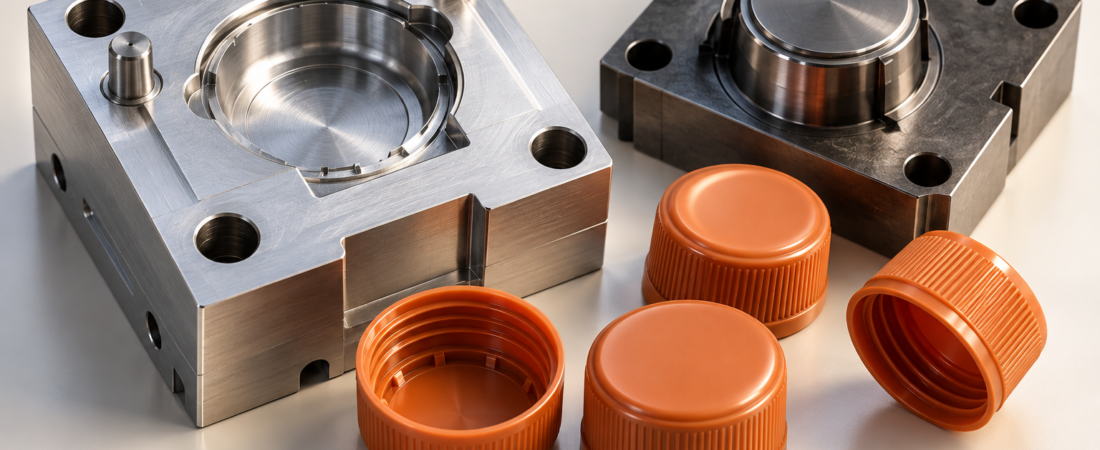
AI concept illustration. Generic tooling and cap samples, not a Mincong prototype service, validated mould design or material certificate.
Define what “soft tooling” means in the quotation
The term can describe different prototype or limited-run tooling arrangements. Ask the supplier to name the cavity and core materials, included mechanisms, cooling, gate and intended use. An aluminium mould, a simplified steel insert and a non-metal printed insert are not interchangeable proposals.
Protolabs describes aluminium tooling as one route for prototype and lower-volume injection moulding, with suitability depending on material and geometry. Its own production thresholds and lead times are supplier-specific. Do not transfer them into a cap project or assume that an aluminium mould is suitable for every release mechanism.
Fund the trial that resolves the expensive uncertainty
For a screw cap, the unresolved issue may be engagement and opening behaviour on an existing bottle. For a flip-top, it may be whether the hinge, lid and latch can operate together. For a dispensing cap, it may be access, grip or the interaction between the outlet and the intended product.
Write the decision the samples must enable: retain the design, revise a named feature, or abandon a route that fails its requirement. Where appropriate, ask whether a replaceable feature insert could compare alternatives without remaking the whole prototype. That is a tooling proposal to evaluate, not a promise that every critical feature can be exchanged independently.
Keep the functional conditions representative
Use the intended resin grade where feasible and identify any difference in colour, additives, gate position, surface or moulding route. A fit sample from one material cannot settle the behaviour of another. If the prototype differs from the intended production design, name the question that remains open.
For PP living hinges, flow and hinge formation matter as well as the nominal geometry. A simplified prototype gate can change what the hinge sample demonstrates. Use the living-hinge design guide to define the relevant features, and keep a printed appearance model separate from an injection-moulded functional sample.
Transfer conclusions feature by feature
| Prototype result | Useful conclusion | Still needs production validation |
|---|---|---|
| Matched bottle and cap engage as intended | Supports that tested interface and sample condition | Full cavity set, conditioning and agreed package tests |
| Hinge and latch meet the defined sample test | Supports the tested material, geometry and formation route | Production gating, closing sequence and repeated operation |
| A design option improves handling in the intended use | Helps select the preferred product feature | Final material, texture and manufacturing consistency |
| Parts mould acceptably at the prototype's operating condition | Shows that the tested combination can produce those samples | Production cycle, cooling, runner balance and accepted output |
The purpose is to carry forward evidence while keeping its boundaries visible. Avoid using a prototype run's best cycle as the target guarantee for a different production tool.
Skip a separate prototype when it does not reduce the risk
If the design and matching components are already well defined, a separate prototype mould may add cost without settling the main uncertainty. Alternatives can include dimensional review, a fit model, simulation within its modelling limits, or a controlled development provision in the production tooling. Select the route around the unresolved question and the consequences of being wrong.
For material and durability selection in production tooling, see the cap mould steel-selection guide. That is a different decision from whether to fund a prototype experiment.
Bring the experiment into the mould review
Send the cap and bottle references, target resin, unresolved features and the test that would enable approval. Mincong can review those requirements within a flip top cap mould discussion; a separate prototype or soft-tool supply scope must be confirmed before quotation. This article does not announce an aluminium-tooling service or a standard prototype lead time.
Request a project review that separates product learning from production acceptance.
Technical references and scope
References checked on 2 November 2026. Supplier documents describe their own materials or equipment. Project review and acceptance proposals above need confirmation for the actual product, material and production system.