Plastic injection mold polishing should restore the required steel surface while protecting the geometry that forms the part. A bright cavity is not a complete repair result if its sealing detail, shut-off, thread or release behaviour has changed.
For a packaging mould, define the surface problem and the protected features before selecting the finishing route. Some conditions can be addressed by controlled surface preparation; others require a repair or replacement decision rather than further polishing.
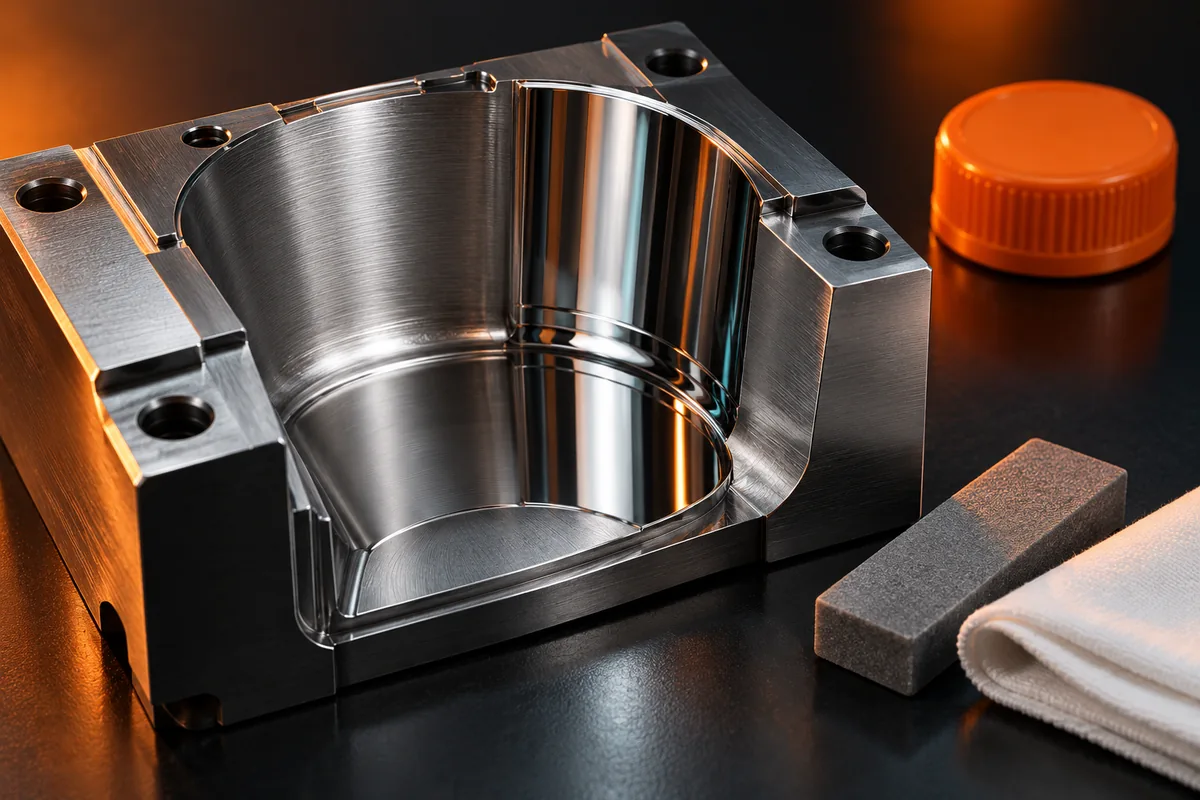
Give the finish a functional boundary
Mark the area to be treated on the tool or part drawing. Identify adjacent sealing lands, parting interfaces, edges, threads, vents and other features that must retain their intended form. State which surface requirement applies to each region.
A general request for mirror finish leaves too much unresolved. A decorative panel, a forming core and a shut-off do different jobs. The desired reflection on one does not establish the appropriate finish on another.
For initial appearance selection, use the cap texture and surface-approval guide. The concern here is narrower: how to remove a surface problem without quietly changing the tool that has already been defined.
Where dimensions are critical, agree the inspection references and permissible change with the tool designer. Steel-surface condition and the resulting plastic dimensions require their own evidence.
Resolve the preparation problem before pursuing final shine
Identify whether the observed condition is a deposit, a scratch, remaining machining texture, corrosion damage or another steel-surface issue. Removing contamination and removing steel are different work scopes. A clean inspection can prevent unnecessary material removal.
Uddeholm's polishing guidance emphasises surface preparation, cleanliness and the effect of the starting condition. The finishing specialist should select the appropriate stage for the actual defect and material. A final polishing operation cannot be assumed to remove deeper damage efficiently or uniformly.
For a local scratch, compare the depth and surrounding geometry with the intended finishing allowance. If the proposed work would change a functional feature, ask for an engineering repair proposal instead of permission to continue until the scratch disappears.
This decision is especially useful around an insert edge: improving a small reflection should not create a step or an uncontrolled transition in the moulded part.
Stop when further polishing worsens the surface
Uddeholm describes over-polishing problems including orange-peel appearance and pitting. Continued work under the same conditions is not automatically an improvement, and the steel's condition affects how it responds.
The appropriate response is for the finishing specialist to reassess the preparation route, tools and method. Keep the approved geometry boundary visible during that review. Do not convert a surface problem into an open-ended allowance to remove more material.
Cleanliness between stages also matters. An inappropriate carryover of abrasive can undermine the intended result. Define responsibility for cleaning and protecting the insert during handling, rather than treating it as an incidental workshop detail.
No universal abrasive sequence is prescribed here. A procedure for one steel, hardness or surface condition should not be copied into a different mould's service instruction.
Choose a release surface rather than maximum gloss everywhere
Uddeholm notes that a smoother tool surface can, in some circumstances, increase polymer adhesion and release force. That is why a brighter surface is not proof that a sticking problem has been solved.
If release damage prompted the polishing request, review the contact mechanism, draft, texture, geometry and operating condition with the tooling team. The drag-mark investigation helps establish when and where the damage appears.
A suitable response may be a controlled functional finish on one region while preserving a higher-gloss appearance surface elsewhere. The actual choice depends on the material and component. It should be agreed before the finisher attempts to make every surface look alike.
For a flip-top cap, protect the approved hinge, sealing and engagement features while evaluating that choice. Their required behaviour is more important than a uniform reflection on the exposed steel.
Escalate from finishing to repair when the geometry requires it
| Condition under review | Possible route for the tooling team | Release evidence |
|---|---|---|
| Removable deposit on an intact surface | Approved cleaning and inspection | Surface condition and representative parts |
| Surface damage within a controlled finishing allowance | Defined local preparation and polishing | Protected dimensions, finish and affected part function |
| Damage that exceeds the agreed boundary | Engineering repair or insert replacement proposal | Revised geometry, interface and production verification |
| Recurring sticking despite acceptable finish | Release-system and process review | Demonstrated removal without the original damage |
The table supports a repair decision; it does not assign a method from a photograph alone. Any additional operation should retain the original reference, drawing revision and acceptance basis so the result remains assessable.
Verify the plastic result as well as the steel surface
Inspect the finished tool against the agreed requirements, then assess moulded parts with the intended resin and colour. Use consistent viewing conditions and repeat the dimensional or functional checks relevant to the worked area. Steel appearance alone cannot represent all those outcomes.
For a flip-top cap mould review, send a marked drawing, the finish reference and the reason for the proposed rework through the project inquiry form. A defined finishing boundary makes it possible to compare surface restoration, geometry repair and a different release solution on a useful basis.
Technical references
General technical references; project settings follow the specified material and installed equipment documentation.