
A lighter bottle handle is useful only if it still assembles reliably, stays attached and carries the intended filled bottle comfortably. Discuss these requirements with the mould manufacturer before fixing the target part weight. The design task is to decide where material is needed and where it may be reduced—not simply to make every section thinner.
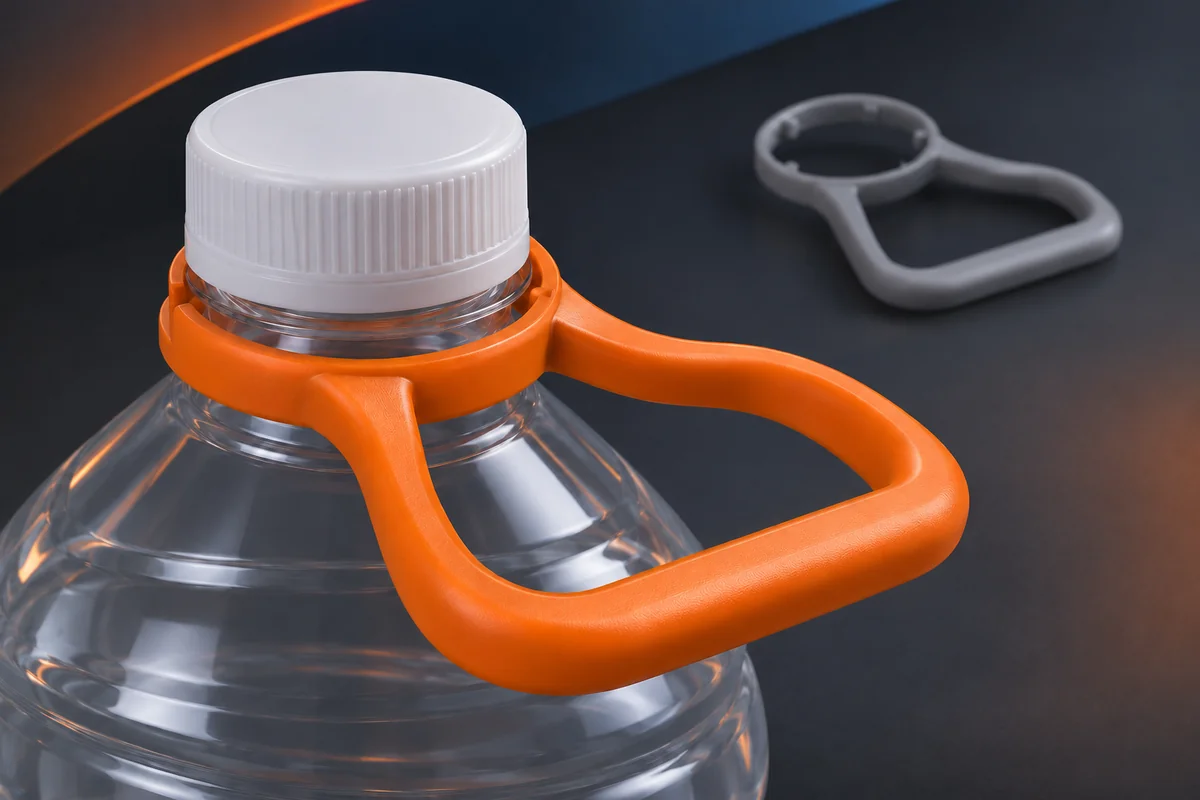
Mincong’s water-bottle handle materials identify the bottle connection as a design consideration. Our oil-bottle handle materials describe different grip formats, including two-, three- and four-finger designs. For a new project, these details should be reviewed together with the actual bottle, material and carrying requirements.
Define what “better quality” means for the handle
For a bottle handle, quality should be assessed through its function as part of the assembled package:
- Reliable attachment: the handle seats correctly and stays engaged during the agreed lifting assessment.
- Resistance to damage: the retaining ring, connecting sections and grip meet the agreed criteria for cracking, tearing and permanent deformation.
- Comfortable handling: the finger opening and contact edges suit the intended grip and provide clearance from the bottle and closure.
- Consistent production: samples across the mould cavities meet the agreed fit, weight, appearance and functional requirements.
These outcomes need project-specific acceptance criteria. A good-looking sample or a low gram weight does not establish all four.
Ask the mould manufacturer to review three critical areas
The retaining ring and its engagement features. Provide the neck drawing and actual bottles. Ask the manufacturer to review the seating position, the installation route and the engagement beneath the bottle’s retaining feature. If the handle releases because it is not fully seated, making the grip heavier will not correct that interface.
The connections between the ring and the grip. Ask which transitions deserve closer structural review before reducing material. Discuss the section changes, corner geometry and any proposed local reinforcement. The manufacturer should explain why a feature is being retained or changed; reinforcement is a design option to evaluate, not an automatic improvement.
The grip and finger-contact surfaces. Review the opening, edge shape and clearance in the carrying position. A lighter version should still be assessed on the filled bottle. A comfortable-looking outline on a drawing is not enough to approve how it feels in use.
Use tooling experience to make the lighter design manufacturable
Bring the mould manufacturer into the discussion before the product drawing is frozen. Ask how the proposed geometry affects filling, gate position, weld-line location, cooling and release from the mould. Where a weld line is expected near a critical connection, ask how that location will be assessed in the trial rather than assuming it is acceptable or defective.
Ask the manufacturer to identify which areas are realistic candidates for weight reduction and which should remain unchanged until samples provide better evidence. A proposal to reduce a broad section, change a transition or add a local rib should include the expected benefit and the points to verify. Avoid accepting “we can make it lighter” without a corresponding explanation of how the handle will be moulded and tested.
The value of experience lies in anticipating these trade-offs and proposing a workable route. It does not remove the need to validate the final design.
Compare weight reduction against usable output
Reducing part weight can reduce resin use when the material and production basis remain comparable. However, compare the cost of an accepted handle, not grams alone. Include the resin grade and price, runner waste, cycle, rejects and assembly performance when evaluating a revision.
Keep a reference design and compare the proposed lighter version using the same defined bottle and test conditions. If the revision needs a different material or production arrangement, include that change in the comparison. Do not promise a saving percentage before those inputs are established.
Approve the lighter handle through an assembled-package trial
Check installation and retention separately, then assess the filled package under the agreed carrying conditions. Where relevant, define repeated lifts, holding time and temperature conditioning with the packaging team. Compare identified samples from the different mould cavities so that one selected sample does not stand in for the whole mould.
If the handle fails, locate the failure before choosing the next change. Ring release, damage at the ring-to-grip connection and grip deformation call for different investigations. Review the affected feature with the mould manufacturer and test the revised proposal against the same acceptance criteria.
For a bottle handle mould project, send the neck drawing, bottle and handle samples where available, proposed resin, filled-package use and target weight. Discuss where weight may be removed and which functional details must be protected. The goal is a lower-cost handle that meets its agreed requirements consistently.