PRODUCT APPLICATION
Carbonated Drink PET Preform Moulds for a Defined Pressure-Bottle Programme
A carbonated drink PET preform mould should be specified from the complete pressure-bottle programme. Mincong reviews the proposed preform tooling against the bottle design, neck and closure, named PET grade and intended blowing equipment. This is an enquiry route for a defined application; pressure resistance and carbonation retention must be established on the finished package, rather than inferred from a clear preform.
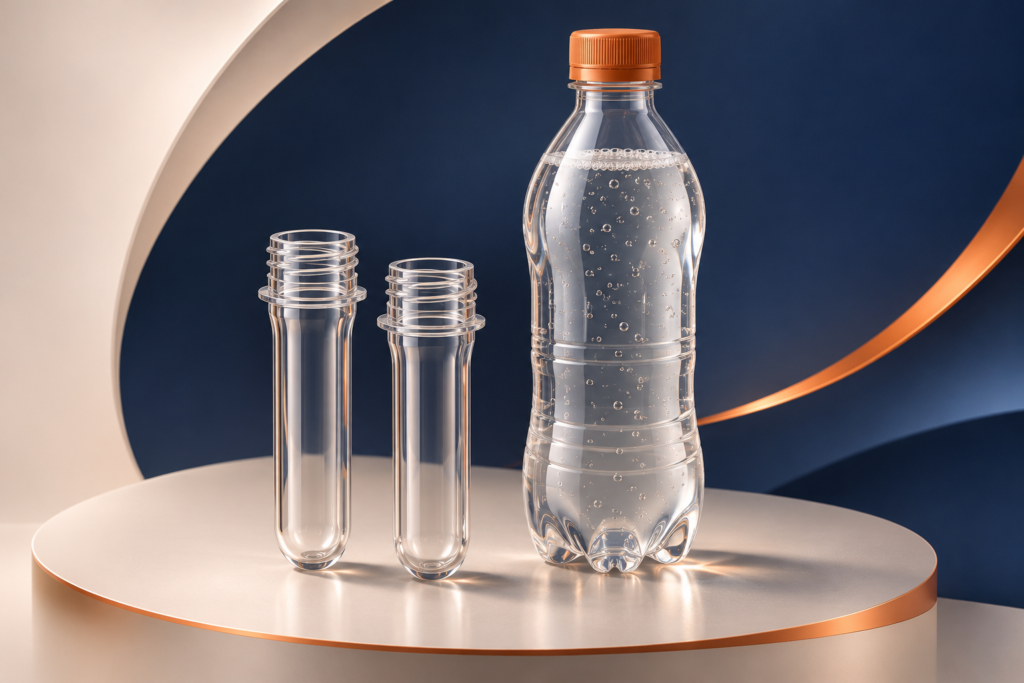
Begin with the filled package requirements
Provide the bottle drawing, beverage and carbonation requirements, filling conditions, distribution temperatures and required package tests. Identify the closure and the owner of the bottle-performance specification. A bottle capacity alone does not define the preform geometry or an acceptable pressure package.
Husky identifies carbonated soft drinks as an application requiring pressure-oriented preform design. That application reference does not establish a universal preform weight, wall section or resin grade. For a new bottle, agree who develops and validates the bottle/preform combination before the production tool is released.
Keep the neck and closure under drawing control
The neck finish must match the actual closure, including the intended sealing and opening behaviour. Send the approved neck drawing and cap samples where available. Similar nominal neck diameters do not establish interchangeable threads, seal lands or support-ring interfaces.
If the closure or neck is changing, review that change with the bottle owner and capping team before freezing the neck-ring tooling. Our PET neck-finish interface guide explains why a local drawing change can affect several downstream operations. Do not use a successful still-water cap fit as approval for a carbonated package.
Develop body distribution with the blowing route
Review preform mass, body length, wall distribution and gate region with the intended bottle and blowing equipment. The practical question is whether the proposed preform can deliver the required bottle distribution within the agreed production route. Adding mass without resolving distribution can leave the underlying package problem open.
An existing accepted bottle/preform pair is a useful starting reference, provided its material and process are identifiable. For a new combination, define the trial quantities and downstream trial responsibilities. The preform weight and wall-thickness article provides the supporting design discussion without prescribing a universal weight.
Agree what the mould quotation includes
| Project item | Required basis |
|---|---|
| Material | Named PET grade, colour/additives and any separately qualified recycled-feedstock proposal |
| Cavity layout | Accepted-output target, preform geometry, injection-unit capability and mould envelope |
| Runner and gate | Proposed system, gate condition, temperature/control interfaces and service scope |
| Cooling and removal | Available utilities, neck/body cooling needs and receiving or post-mould handling |
| Equipment fit | Actual machine interface drawings, strokes and available utilities |
| Acceptance boundary | Preform inspection plus responsibility for bottle and filled-package validation |
Where YUDO is proposed, the quotation should identify the applicable system and control arrangement. A Husky option requires confirmation of application, integration and supply scope for the Mincong project. A supplier name is not a substitute for a defined gate or machine interface.
Separate tool acceptance from package approval
Assess the moulded preforms for the agreed dimensions, gate condition, appearance and cavity consistency. Then evaluate the bottles produced from those preforms using the agreed blowing and packaging route. Assign responsibility for pressure-related testing, closure performance and any carbonation-retention requirement before accepting the commercial scope.
Cycle and output proposals must identify the preform, resin, cavity count, machine and cooling/handling arrangement. This page offers no generic burst pressure, shelf life, cycle or mould-life promise. The PET preform mould overview remains the main product-range page.
Request a project-specific tooling review
Send the bottle and preform drawings or samples, neck/closure information, PET grade, package requirements, output target and machine data. State whether you need a new preform design, tooling for an approved design, or a review of an existing programme.
Discuss a carbonated drink preform mould
Explore Related Packaging Moulds
Swipe or use the arrows to explore other tooling scopes.
Water Bottle PET Preform Moulds
A separate programme for the agreed water bottle and filling route.
Explore product →Edible Oil PET Preform Moulds
Oil-bottle interfaces, filling and handling requirements.
Explore product →Wide-Mouth PET Preform Moulds
Jar necks and blowing requirements reviewed separately.
Explore product →Technical references and scope
References checked on 4 November 2026. Supplier documents describe their own materials or equipment. Project review and acceptance proposals above need confirmation for the actual product, material and production system.