A polypropylene vs ABS comparison for a cap project should start with the component's job. A one-piece hinged closure, a sealing component and a separate outer cover may look like parts of the same package, but they do not share an identical material requirement.
Define what the proposed material must do before comparing resin prices or approving a mould. Our plastic cap injection molding overview introduces the production route. Here the question is how a buyer can make a useful PP-versus-ABS decision without turning a general material comparison into permission for an unreviewed substitution.
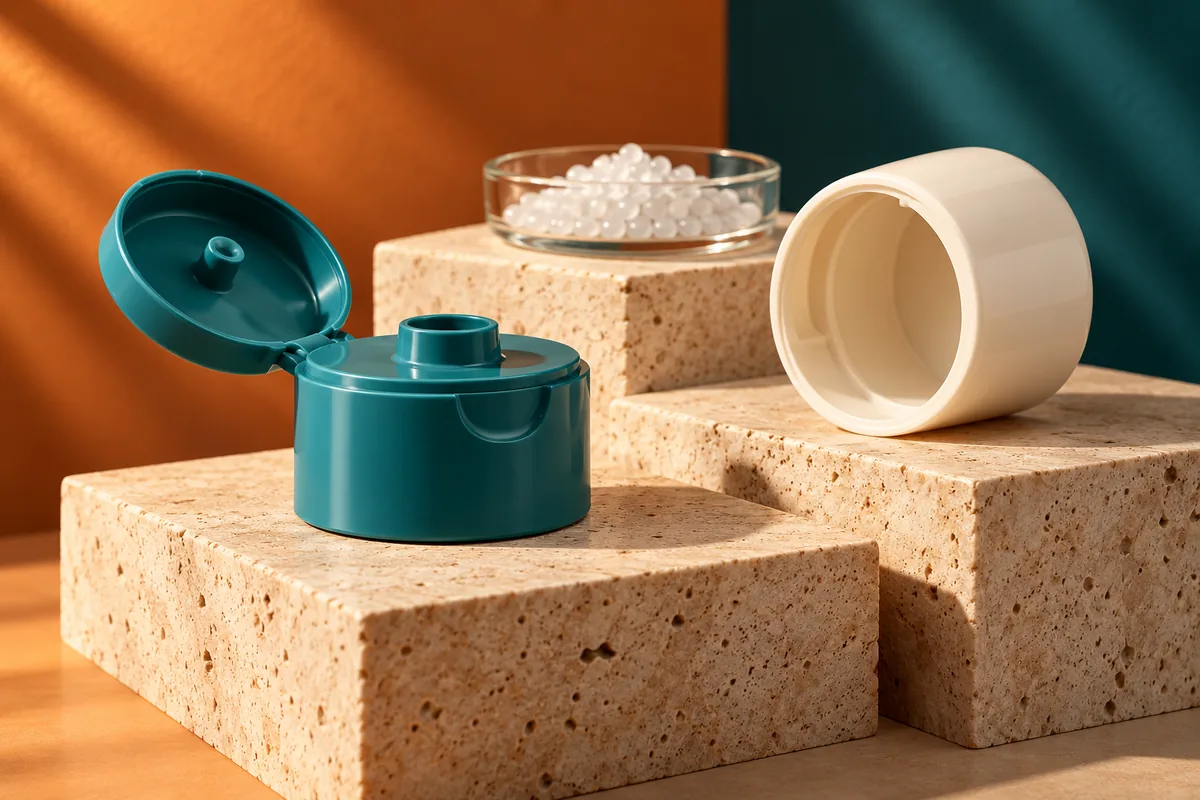
Separate the functional closure from an outer cover
Mark the component on the package drawing. Does it contain the hinge, make contact at a sealing interface, retain another part, carry a decorative finish or perform several of these jobs? Identify the surfaces and movements involved.
For an integral flip-top, the lid and body are moulded as a connected part. A separate cosmetic cover is a different component proposal. Selecting a material for one does not settle the material for the other. If an enquiry simply says “plastic cap,” resolve this scope before the tooling team assesses the design.
This distinction also keeps appearance samples useful. A sample may help agree colour, texture or overall form. Ask whether it also represents the intended polymer, manufacturing route and functional configuration. Record what it demonstrates and what still requires assessment.
Treat the living hinge as an early material decision
The INEOS polypropylene processing guide identifies integral hinges as an established PP application. It relates performance to material behaviour and the moulded section, rather than to the family name alone.
For a cap with a repeatedly flexed hinge, we recommend asking the resin supplier for a grade-specific assessment of that duty. Keep the intended use and production route beside the material recommendation. Do not assume an ABS appearance prototype qualifies a PP hinge, or that an unspecified PP grade automatically meets the required opening life.
Our PP living-hinge design review addresses geometry, filling and the first fold. Use that review after defining the candidate material; this comparison does not provide a replacement hinge section or a fatigue-life guarantee.
Compare named grades under comparable conditions
PP and ABS each contain multiple commercial grades. INEOS's PP overview distinguishes homopolymer, random-copolymer and impact-copolymer families. Its ABS product finder likewise lists grades with different flow, impact and appearance descriptions. A family-level label is a starting point for screening, not a complete purchase specification.
Ask for the current technical data sheet and processing instructions for each actual candidate. Compare the property, test method, temperature and conditioning associated with a value. Keep the intended colour formulation and any proposed filler or recycled content identified in the material definition.
Avoid deciding that one family is universally stronger, more heat resistant or more dimensionally accurate. Protolabs' comparison explicitly qualifies its typical values by grade, thickness and geometry. For a closure decision, use applicable grade evidence and package requirements rather than a generic ranking.
Put the intended contents and finish into the brief
Define the contents, contact surfaces, expected storage and use conditions, and any cleaning or other exposure relevant to the package. Ask the material supplier which supporting information applies to those conditions. If suitability remains unresolved, keep it as an approval item rather than inferring compatibility from a polymer-family description.
Where food, medical or another controlled application is intended, request the documents applicable to the actual grade, formulation, market and use. “PP” or “ABS” alone does not establish that the proposed finished component meets the order's requirements. This is a documentation checkpoint, not a regulatory certification by the toolmaker.
If the component will be printed, painted, plated or otherwise decorated, identify the intended system and responsible supplier. Include its appearance and durability requirements in the review. An undecorated material sample does not demonstrate the final decorated package.
The following is a suggested decision record, not a universal material-selection standard:
| Decision | What to identify before approval |
|---|---|
| Component role | Functional closure, integral hinge, separate cover or other defined part |
| Candidate material | Manufacturer, grade, colour formulation and current document revisions |
| Use condition | Contents, contact, handling, storage and required exposure checks |
| Appearance | Approved colour, texture, decoration and viewing reference |
| Tooling basis | Drawing revision, material-dependent assumptions and proposed production route |
| Acceptance | Identified samples, applicable functional checks and approval authority |
Reopen the tooling review when the material changes
If a project proposes changing from PP to ABS, or the reverse, issue a material-change review before authorising production. Ask the toolmaker which assumptions need reassessment: dimensional allowances, filling, thermal conditions, release, interfaces and the requirements of any hinge or retention feature.
This does not mean that every change requires a new mould. It means that the existing tool's suitability must be established for the proposed material and part requirements. Obtain the assessment before promising reuse, insert replacement or a particular correction cost.
For the mating interface, continue to the bottle-neck fit and sealing guide. For how dimensions will be judged, use the cap inspection agreement guide. Keep appearance, measured fit and package function as distinguishable results in the material comparison.
Retain the approved-material samples beside the alternative samples, with their identities clear. Agree which checks will justify the decision and how any remaining exceptions will be handled. A visually similar alternative is useful to inspect, but the required functions still need their own evidence.
Resolve the material choice before comparing the tooling offer
Compare offers using the same component definition and named material basis. If a supplier proposes another grade or family, request the reason, the affected assumptions and the confirmation work included in its proposal. A resin-price difference alone does not establish the total cost of an accepted closure.
For a flip-top cap mould, send the component drawing, intended use, candidate grade and closing requirement through our project review form. If the material is undecided, say so. The next useful step is a defined material and tooling review, followed by agreed sample evidence—not a promise that one polymer wins every comparison.