An undercut in injection molding is a feature that obstructs release along the proposed tooling direction. In a plastic cap, a thread, internal bead or recessed detail can create that obstruction. Whether it does depends on the feature and the chosen mould arrangement—not simply on how complicated the cap looks.
For a buyer, the decision is practical: can the proposed tool release the approved closure while preserving its seal, engagement and appearance? Review that question before committing to the cavity layout. This article covers the release-route decision; the plastic cap injection molding overview explains the wider production sequence.
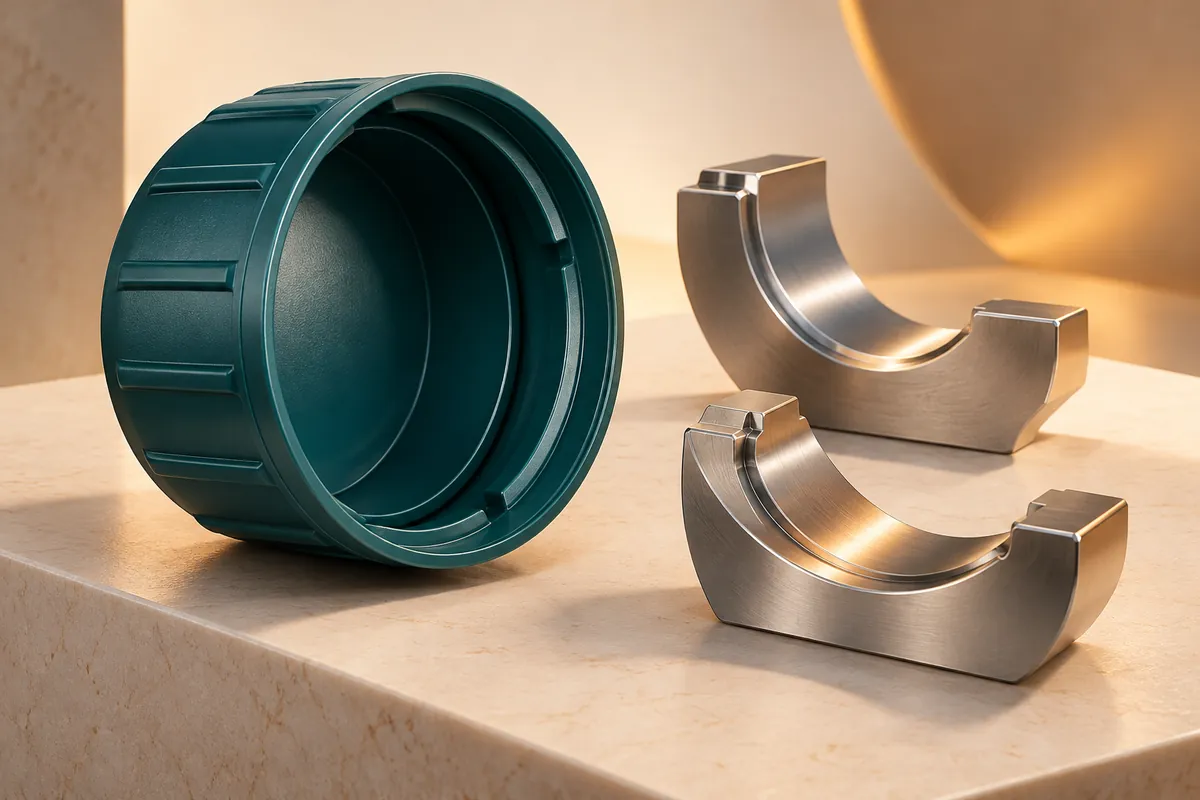
Locate what is trapped, and in which direction
Start with a section through the feature, the proposed mould-opening direction and the tooling surface that forms it. Ask the designer to identify what would interfere during a straight withdrawal. A shaded CAD undercut analysis can help locate concerns, but the review should still explain the actual relative movement.
Record the feature's purpose beside it. A retaining bead may be essential to attachment; a sealing lip may control a different package function. Removing or reducing either feature just to simplify release needs approval from the person responsible for the closure design.
Consider a hypothetical cap with an inward-facing annular bead. The first question is which tooling surface sits behind that bead. The next is how that surface and the plastic become clear of one another. A photograph of the finished cap cannot answer both questions.
Compare concepts against the same closure requirements
Protolabs' undercut design guidance describes several approaches, including parting-line changes, side-actions and elastic release. These are routes to assess, rather than interchangeable features to add to every cap mould.
Use the following as a project discussion table. It does not select a mechanism without the part and material review.
| Proposed route | What the buyer should ask to see |
|---|---|
| Adjust the part geometry or parting arrangement | Revised feature, affected package functions and the appearance of the proposed split |
| Strip the part over a forming feature | Geometry and material assessment, supporting contact areas and the checks for permanent distortion or damage |
| Withdraw separate tooling | Which surface moves, the clearance it creates and the condition required before ejection |
| Release a thread by relative rotation | Thread definition, cap restraint and coordinated axial clearance |
An apparently simpler concept can transfer a requirement elsewhere. For example, a change that improves release might alter retention on the bottle. Compare alternatives against one approved closure specification, not against appearance alone.
Do not approve stripping from the resin family alone
Elastic release relies on temporary deformation sufficient to clear the obstructing feature. Its suitability depends on the local geometry and material behaviour. A statement such as “it is PP, so it can strip” leaves the important assessment unfinished.
Provide the actual grade and colour-system specification. Ask the tooling team which part regions deform, which surfaces support the load and what conditions the assessment assumes. Keep that explanation with the drawing revision.
For the hypothetical annular bead, agree how samples will be examined for whitening, tearing, residual shape change and the required attachment function. These are suggested checks to select for the project, not a claim that every stripped cap will exhibit those problems.
Mould release also differs from snapping a cap onto its container. The mating surfaces, loading and temperature conditions are different. Our snap-fit closure design guide addresses assembly and use requirements separately.
Ask what must clear before the next movement
Where separate tooling is proposed, request a simple explanation of the movement sequence and the available clearance. Protolabs' side-action guidance explains the basic principle: tooling that traps the part must withdraw sufficiently before ejection. Its own service-specific dimensions are not limits for a Mincong project.
For a threaded design, continue to the unscrewing mould design review rather than approving a rotating core from its name alone. That review covers restraint, rotation and axial movement in more detail.
Ask the supplier to list machine connections, movement-confirmation responsibilities and maintenance access for the actual concept. Leave unconfirmed requirements open in the quotation. A rendering can explain the arrangement; it cannot demonstrate clearance under load or acceptable released parts.
Make the trial answer the original design question
Before the trial, select the features and functions that could be affected by release. Agree sample identification by cavity and how the relevant sample condition will be recorded. Preserve an accepted reference and the associated drawing revision.
The useful result is more specific than “all caps ejected.” Check the released feature, any support-contact region and the required mating function. If a change is proposed, identify whether it affects tooling only or also changes the approved product geometry.
For example, if a retaining bead is reduced after the first trial, repeat the affected engagement checks. A cleaner release does not establish that retention is unchanged. If unexplained marks appear, use the cap drag-mark investigation to locate when they arise before authorising further surface work.
Questions buyers often ask
Does every undercut require a slider?
No. The relevant options depend on the feature, tooling direction and material assessment. Ask why the proposed route suits this cap and which product requirements it preserves.
Can additional draft remove an undercut?
Draft can assist withdrawal, but it does not automatically clear a feature that remains mechanically trapped. Review the actual section and any proposed geometry change.
What should accompany an undercut review request?
Send the cap model or sectioned drawing, mating-part reference, resin grade, intended output and injection-machine information. Mark the feature that concerns you and state its function. For a water or beverage cap mould or another closure, request a mould review with those inputs so the release route can be assessed for the actual project.