ENGINEERING NOTES
When a plastic closure cracks after assembly or storage, correct the combination of stress, geometry and exposure rather than automatically increasing wall thickness. Environmental stress cracking is one possible explanation, not a diagnosis from a photograph. Separate damage already present during moulding or capping from delayed failure before selecting the remedy.
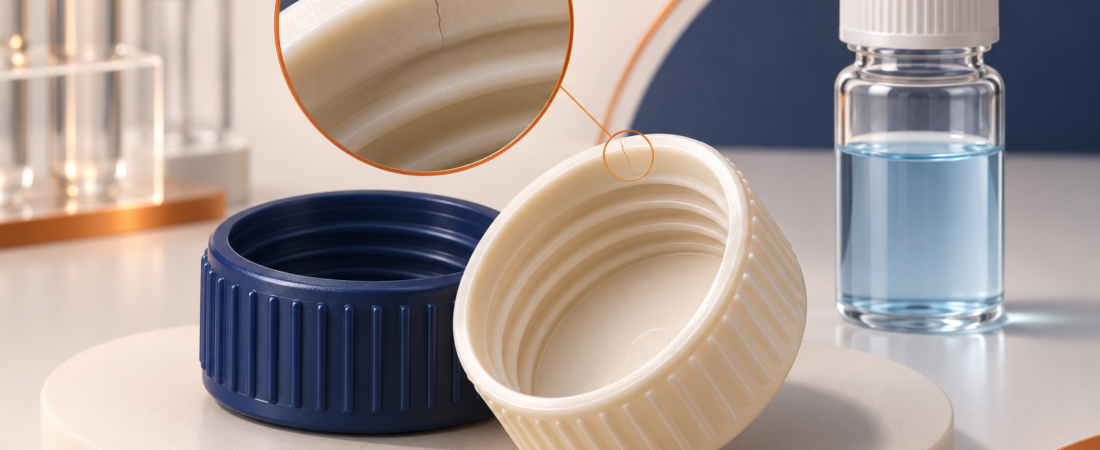
AI concept illustration. A crack and liquid suggest an investigation topic; they do not prove chemical causation or show a tested formulation.
Establish when the damage begins
Compare unused caps, newly applied caps and the relevant stored packages. Identify whether the first damage appears during mould release, initial tightening or later exposure. White marks alone do not establish a crack, and an immediate break under excessive load is not automatically an environmental-stress-cracking event.
Retain matching bottles, material and colour details, filling conditions and the actual product formulation for the responsible investigation. If the cause is uncertain, use suitable failure analysis. Do not replace evidence with a generic chemical-resistance chart for a polymer family.
Correct unnecessary assembly load first when it is established
Check the cap against the approved bottle neck and capping conditions. Interference at the wrong surface, an unintended hard stop or excessive application load may require an interface or assembly correction. Simply reducing application torque without checking seal performance can create a new leak problem.
Where assembly is the identified driver, restore the intended contact sequence and agreed operating range with the packaging team. Validate opening, retention and sealing together. The bottle-neck fit and sealing guide provides the interface review; use the actual matched parts rather than nominal diameters alone.
Remove a local stress concentration when the geometry supports it
If failure repeatedly initiates at a particular feature, compare that location with the drawing and moulded result. A sharp transition, local damage or distorted section may justify a targeted geometry or tooling correction. Confirm the proposed change against mould release, filling and the adjacent sealing features before cutting steel.
Making the whole cap thicker is a poor substitute for resolving a specific concentration of load. It can alter cooling, shrinkage and flexibility while leaving the initiation site unchanged. Use a controlled geometry revision and trial the resulting package rather than assuming more plastic guarantees resistance.
Match the resin to the real exposure
Discuss the actual formulation, exposure temperature, duration and stressed use condition with the resin supplier. A material that appears satisfactory without load may not establish the same performance in the assembled cap. LyondellBasell lists stress-crack resistance among the relevant closure-material requirements; a polymer name alone is therefore insufficient for selection.
If a different grade or colour system is proposed, compare it under an identified process and matched packaging configuration. Recheck dimensions and functional behaviour after the change. The PP versus HDPE selection article covers the broader functional choice, while material-change qualification addresses manufacturing consequences.
Use a test that answers the packaging question
ASTM D5419's public scope covers environmental stress cracking of threaded closures and identifies design, material and stress variables. Its published significance also cautions that a test's failure time needs correlation with actual packaging before being used to estimate field life. A short accelerated exposure must not become an unsupported shelf-life guarantee.
Agree the appropriate complete method, sample conditioning, application condition, formulation and acceptance criteria with the responsible laboratory or customer. The suggestions here organise an investigation; they are not a reproduction of the paid standard or a claim that Mincong has certified this package.
Select the correction that preserves the whole closure
For an established assembly problem, correct the interface or applied load and verify sealing. For an established local geometry problem, trial a targeted revision. For a material/exposure problem, qualify the candidate grade and packaging system. More than one route may be necessary, but keep each intervention identifiable so its effect can be assessed.
Bring delayed-cracking problems into a functional closure mould review with failed and unfailed samples, neck drawings and exposure conditions. Send the project information before specifying an irreversible tool correction. No universal chemical compatibility, service life or torque value is offered.
Technical references and scope
References checked on 4 November 2026. Supplier documents describe their own materials or equipment. Project review and acceptance proposals above need confirmation for the actual product, material and production system.