Injection mold steel selection should produce a component-level specification, not just a prestigious grade name on the front of a quotation. A cap mould combines forming surfaces, supporting plates and components with different duties. Buyers need to know where each material goes, its supplied and finished condition, and what records will establish acceptance.
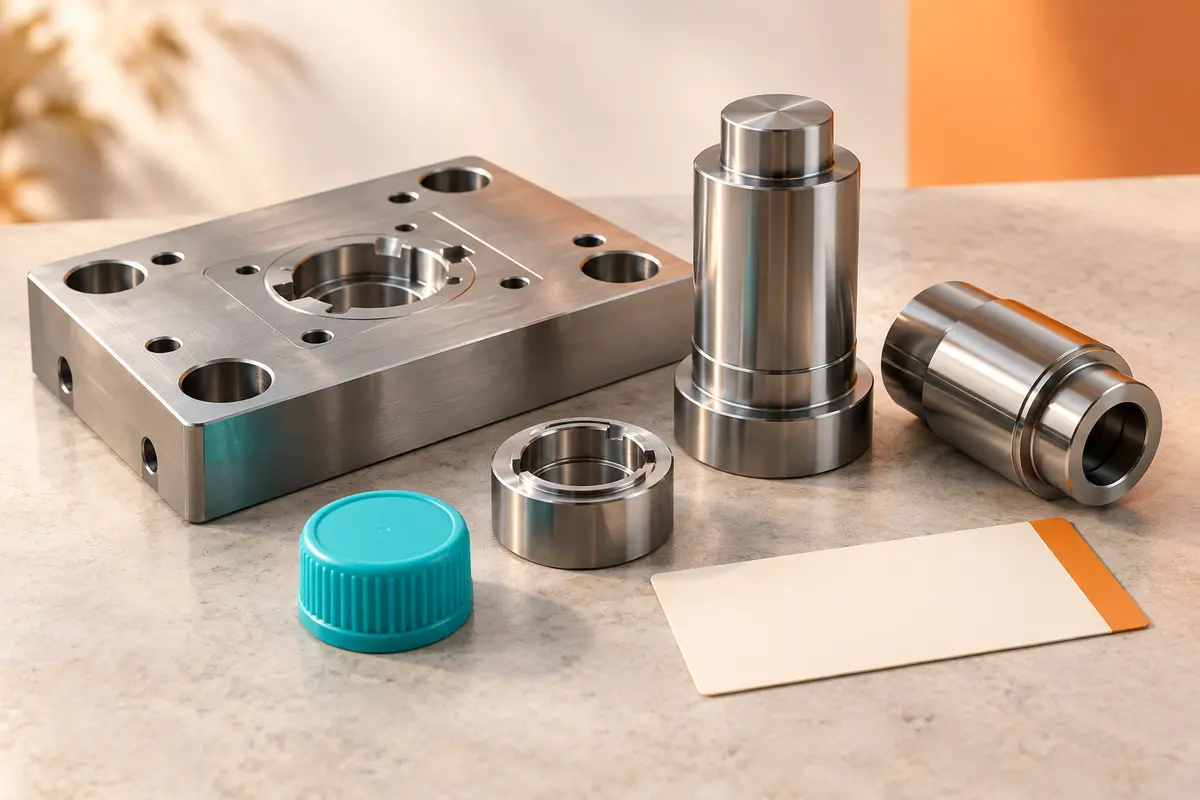
Use the following review before material release. Our cap mould manufacturer RFQ checklist covers the wider supplier comparison; this guide focuses on the steel agreement itself.
Start with the closure and the service requirement
Give the tooling team the cap drawing, resin grade and colour or additive requirements, expected production programme, surface reference and maintenance environment. Identify sealing lands, threads, hinge-forming details or other features whose condition matters to the finished closure.
Uddeholm's injection-moulding guidance treats material choice as application-dependent. Its considerations include production quantity, plastic, tool size and finish, together with strength, hardness, toughness, wear, cleanliness, corrosion and thermal behaviour. That supports a balanced review rather than choosing the highest hardness number.
Ask the supplier to state the duty behind each choice. For example, distinguish a cosmetic forming surface from a supporting plate or a replaceable release component. This is a proposed purchasing method, not a requirement to use one grade throughout the tool.
Ask for a material map, not one line for the whole mould
Request a component list tied to the tooling drawing or agreed parts schedule. For each relevant position, the quotation should show the material identity, condition and acceptance evidence. If some proprietary details cannot be shared, agree a purchasing-level schedule that still identifies what is supplied.
| Component group | What to clarify in the quotation |
|---|---|
| Cavity and core inserts | Proposed producer and grade, required finish, final condition and identification |
| Seal or thread-forming details | Functional features, inspection references and replacement scope |
| Stripping, sliding or closing components | Actual contact duty, proposed material or treatment, and service information |
| Mould plates and holders | Separate specification; do not inherit the insert grade by implication |
| Purchased assemblies | Supplier references and the boundary between their specification and the toolmaker's scope |
Use the level of detail appropriate to the project. The table is not a claim that every cap mould contains every mechanism. Its purpose is to prevent the word “steel” from hiding important differences between quotations.
Separate grade identity from delivery condition
A name alone does not show whether a material arrives ready for machining at a prehardened condition or requires a subsequent hardening route. Two official supplier examples illustrate the distinction:
- Uddeholm Impax Supreme is described as a prehardened mould steel supplied at 290–330 HB.
- The Stavax ESR technical brochure lists delivery in a soft-annealed condition at approximately 190 HB and provides separate heat-treatment guidance.
These are examples of documented supply conditions, not interchangeable recommendations for a Mincong cap project. Neither number is a universal finished-component hardness target. They also should not be compared as if HB and HRC were the same scale.
For the proposed material, request the exact producer designation and applicable datasheet. Record the agreed alternative, if any, rather than accepting an unspecified “equivalent.” Similar names in a catalogue do not establish identical composition, cleanliness, processing or suitability.
Define the finished condition and the evidence
Ask which components will undergo heat treatment or surface treatment, and which are intended to remain in their supplied condition. Have the responsible tooling and treatment specialists define the route for the actual component geometry and duty.
Where hardness verification is required, specify the scale, agreed range, test location and relevant component identity. Keep the material certificate, heat-treatment record and component inspection as distinct documents. A certificate identifying a steel batch does not by itself demonstrate the finished part's hardness or dimensions.
Similarly, a surface-treatment result should not silently replace the requirement for the underlying material. Ask what was treated and what the reported measurement represents. Do not infer the whole component's condition from a surface value without the applicable test basis.
Agree these deliverables before manufacture. The cap mould manufacturing-stage guide explains where material release and later component checks fit in the approval process.
Evaluate finish and corrosion without promising a cycle
Identify the surfaces that need an agreed appearance reference and those whose geometry must be protected during finishing. “Mirror finish everywhere” is not a useful substitute for a drawing and inspection requirement.
Uddeholm's plastic-moulding steel guide connects polishing performance with steel cleanliness, and explains why corrosion in cooling channels can impair heat transfer. It also discusses the trade-offs among toughness, wear and thermal properties.
Translate that into questions for the actual production environment: what surface is required, what water conditions and storage procedures are expected, and what evidence supports the proposed material? Do not turn a supplier's general property description into a guaranteed cycle reduction or an assurance that maintenance will be unnecessary.
For service planning, use the separate bottle cap mould maintenance checklist. Steel choice and an agreed maintenance programme should support each other; neither replaces the other.
Make substitution and life claims reviewable
Before accepting the order, agree how a material substitution will be proposed and approved. Require identification of the affected component, the proposed producer and grade, the reason for the change and the supporting comparison. Keep approval with the revised component schedule so the delivered tool can be checked against it.
Treat a mould-life statement separately. Ask what counts as a shot, which components it covers, what maintenance and operating conditions apply, and whether replacement wear parts are included. A steel name is not evidence that a specific number of cycles has been demonstrated.
For a water and beverage cap mould, relate the schedule to the actual closure and production conditions. For a flip-top mould, identify the closing-mechanism components separately where that mechanism is part of the supply.
Send your cap definition, material requirements and open specification questions through our mould project review form. The useful outcome is a clear material agreement that can be followed from quotation to delivery—not a grade label that leaves the supplied condition uncertain.