Injection molding splay is a surface appearance problem commonly described as silver streaking. On a plastic cap, pale or silvery trails may interrupt the intended finish. The description records what is visible; it does not establish whether the cause lies in material condition, thermal history, air or local filling behaviour.
Before authorising a mould change, ask for an identified sample and a short account of when the streaks appear. A useful investigation should explain why the proposed next check fits the evidence, rather than turning a defect name into a standard adjustment recipe.
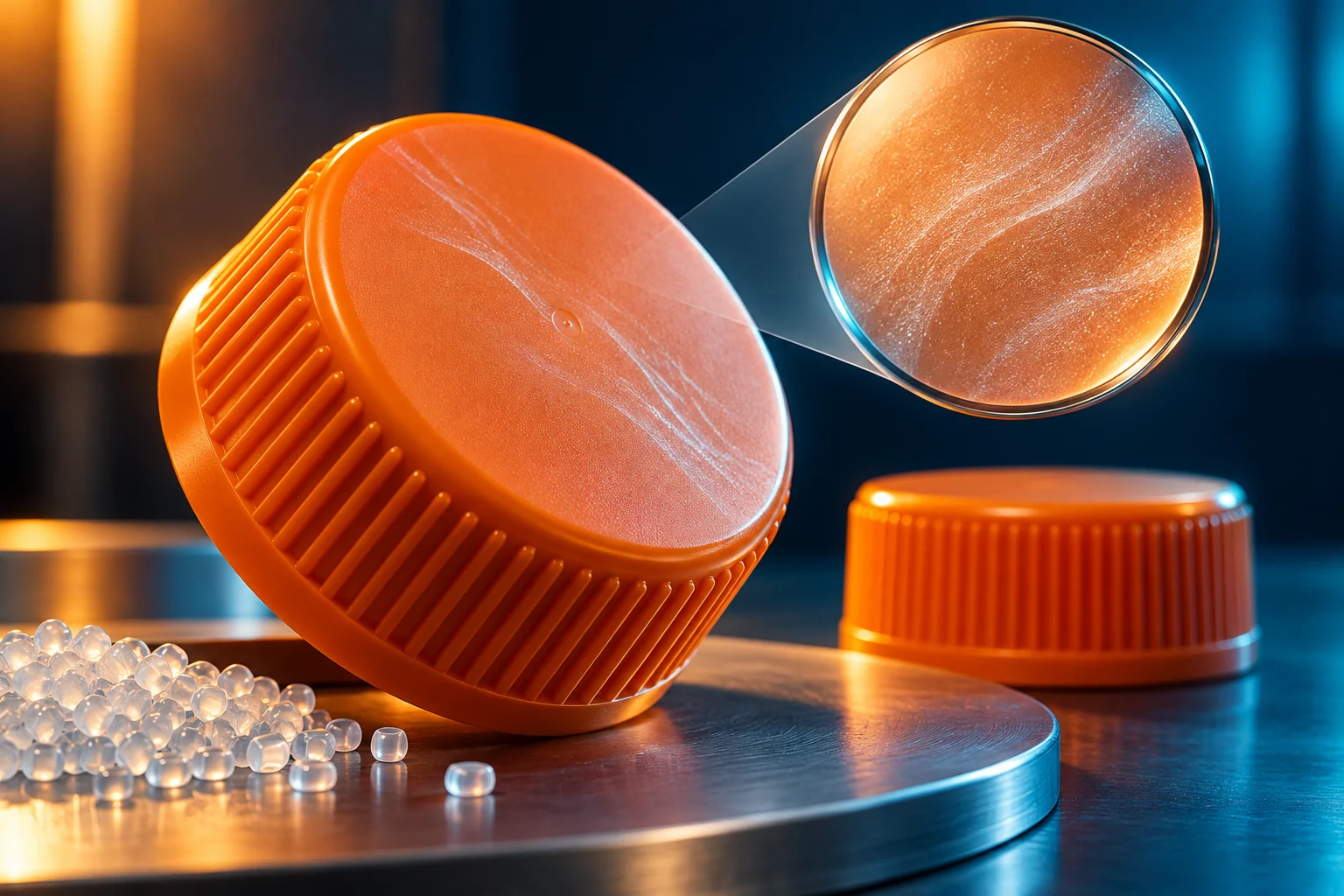
AI-generated concept illustration. The stylised streaks and lens are not a real defect sample, a microscopic image or evidence of a confirmed cause.
Agree what the mark is before discussing a remedy
Photograph the whole cap and the affected area under consistent lighting. Identify the cavity and mark the gate reference on the photograph or a separate sketch. Retain the physical sample when possible: reflections on a glossy cap can change substantially with the viewing angle.
Describe the mark’s location, direction, distribution and visibility. Note whether it is concentrated near the gate, extends across the top, or repeats on the skirt. Keep observations separate from labels such as “wet resin” or “bad venting”. Those labels are hypotheses until checked.
A pale gate-area patch, a scratch and a silvery trail should not automatically share one diagnosis. Our gate-blush review guide addresses the separate question of evaluating a mark around the gate before changing tooling.
For appearance approval, agree the inspection conditions and reference sample with the buyer. A heavily magnified photograph can help investigation without becoming the acceptance standard for normal viewing.
Check the actual material system and exposure to moisture
Record the resin grade and batch, colour concentrate, blend instructions and any permitted regrind. Include the relevant handling instructions from the material suppliers. “PP cap” or “PE cap” alone is not a complete material specification.
INEOS's polypropylene processing guide lists wet material and mould sweating among possible splay-related conditions. That supports checking both feed handling and condensation; it does not justify prescribing the same drying treatment for every cap resin or blend.
Ask whether the issue began after opening a stored bag, changing concentrate, changing the blend or moving material between areas. These are useful comparison points, not proof that any one item caused the streaking.
Where moisture is suspected, ask what was actually checked and how. Distinguish a measured condition from an assumption based on appearance. Any drying decision should follow the applicable grade and additive instructions, with the material supplier involved when those instructions are incomplete.
Keep thermal history separate from the moisture question
Moisture is not the only route to a streaked appearance. Covestro's troubleshooting reference distinguishes moisture streaks from overheating-related silvery streaks and notes their visual similarity. It concerns engineering thermoplastics, so its processing settings should not be copied into a PP or PE cap project.
For a cap trial, retain the start-up and interruption history alongside the samples. Ask whether the issue is present immediately after a restart, continues during stable production, or appears after a material change. Record the sequence without inventing a universal number of cycles that makes production “stable”.
Keep heater settings, controller readings and separately measured temperatures clearly identified. They are different records. If the supplier proposes changing a thermal condition, ask which observation supports that proposal and what will remain unchanged for the comparison.
The purpose is to preserve an interpretable trial history. A cleaner-looking cap after several simultaneous changes does not identify which change mattered.
Use the cavity pattern to organise the next discussion
Compare identified samples across the mould. A shared issue across several cavities may justify an early review of common material or machine conditions. A repeatable mark in one cavity may justify closer examination of that local flow and tooling area. Neither pattern excludes the other possible causes.
Autodesk's technical description also identifies trapped air during filling as a cause of white or silver streak marks. If air or local flow is suspected, ask the tooling team to relate the affected area to the proposed filling pattern and available venting information.
| Observed pattern | Useful next question | What the observation does not prove |
|---|---|---|
| Several cavities change after the same material change | What changed in the resin, concentrate, handling or blend records? | That the mould is free of any contributing issue |
| One cavity repeats a mark in the same place | What local filling or tooling evidence matches that location? | That cutting a new vent is already justified |
| Marks appear mainly after an interruption | What was the documented stop and restart history? | That a particular temperature correction is appropriate |
These are investigation prompts. They are not a diagnostic chart or permission to modify the mould.
Ask for a comparison that can support a decision
Before the next trial, write down the hypothesis, the proposed change, the sample identification and the conditions to be recorded. For a simple comparison, preserve the other relevant conditions as far as practical. If several factors need a coordinated trial, have the process engineer define the comparison explicitly.
Retain representative samples before and after the trial, including the cavity and collection time. Record whether the appearance changed, whether it returned, and which questions remain unresolved. “Looks better” is a useful observation but an incomplete handover.
If inspection or cleaning is required, use the approved site procedure and component instructions. The cap mould maintenance guide explains how to separate observations, authorised service work and verification records.
Decide what counts as an acceptable cap
Resolve appearance against the agreed reference and viewing conditions. Then retain the cap-function checks relevant to the affected area and the approved project requirements. An improvement in silver streaking alone does not establish sealing, opening behaviour, hinge performance or suitability for the intended application.
For a new water or beverage cap mould, discuss appearance expectations and sample traceability before trial approval. For the wider production sequence, see our plastic cap injection molding overview.
When contacting Mincong, send the cap and matching-neck information, the actual material specification and identified photographs or samples. If streaking is already present, include when it started and which cavities are affected. That gives the tooling discussion a concrete starting point without assuming that a mould change is the answer.