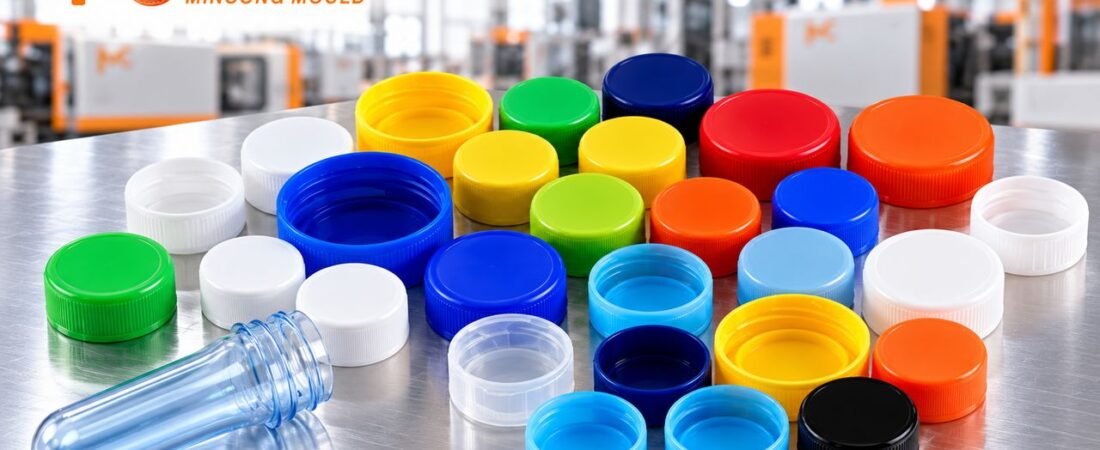
The main types of bottle caps include screw caps, snap-on caps, flip-top caps and dispensing closures. These names describe different aspects of a closure, so they can overlap: a flip-top cap may screw onto a bottle, while its small lid opens on a hinge. Before ordering a mould, describe both how the closure attaches and how the customer uses it.
This guide focuses on plastic closures relevant to a custom mould project. Metal crowns, roll-on metal closures and cork stoppers involve other manufacturing routes.
Classify the cap in three steps
A product name alone often leaves important details unresolved. Separate the closure into three questions:
| Question | Examples | What the answer clarifies |
|---|---|---|
| How does it attach to the container? | Threaded or snap-on connection | Bottle interface and assembly route |
| How does the user access the contents? | Remove the whole cap, lift a lid, press a disc or pull a spout | Opening action and dispensing experience |
| Which additional functions are required? | Tamper evidence, tethering or a separate liner | Extra components, operations and validation |
For example, “snap-on flip-top cap with tamper evidence” is more useful than “flip cap.” It identifies an attachment, a user action and an additional function. It still needs drawings and performance requirements before it becomes a tooling specification.
Screw caps: useful when the whole closure is removed
A screw cap engages a matching threaded neck. The user rotates it to open and reclose the package. This is a familiar option for many beverage, household and oil containers, but the thread itself does not fully define the seal.
During selection, ask whether the user should remove the complete cap each time. Consider grip, opening effort, the space available for the hand and what happens to the loose cap during use. A larger grip area may help handling while also changing cap weight and package appearance.
For detailed interface review, see our bottle cap mould design guide. A nominal diameter alone does not identify a complete neck finish.
Snap-on caps: define attachment separately from opening
A snap-on closure is retained by engagement with features on the container neck. Our snap-fit closure design guide separates assembly, retention and mould release for a tooling review. Some are intended to stay attached during use; others are removable. “Snap-on” should therefore describe the attachment rather than imply a particular opening experience.
A snap-on flip-top may remain on the bottle while the consumer opens only the lid. Discuss how the cap is applied, how attachment is checked and whether removal is intended. Do not substitute a threaded neck drawing simply because its outside diameter looks similar.
For tooling review, identify which retaining features belong to the cap and which belong to the container. Changes to either side require a fresh compatibility assessment.
Flip-top caps: review the lid and the base as a system
A flip-top closure provides access through a hinged lid. In an integral design, the lid and base are moulded together and connected by a living hinge. Other constructions may involve assembled components.
The useful selection questions concern how the package is handled. Will it be used with one hand? Should the lid stay clear of the dispensing opening? Will product collect around the spout? How should the lid feel when it closes?
These questions lead to specific design requirements for the hinge, lid, plug or other sealing feature. The lid-to-base seal and the cap-to-bottle seal are separate interfaces.
Our flip-top cap mould page shows relevant tooling examples. The required closing method is reviewed for the actual cap rather than inferred from its appearance.
Disc-top and spout closures: start with the product being dispensed
A disc-top closure opens a dispensing passage when the user presses one side of a movable disc. A spout closure directs the product through a defined outlet; push-pull designs add their own opening action.
For either type, explain the intended product and user action before selecting a reference cap. A watery liquid, a viscous lotion and a powder create different dispensing questions. Product residue, cleaning expectations and the desired amount per use may influence the design review.
Ask whether the closure is one component or an assembly, and identify who supplies each component. These are closure categories to evaluate, rather than a statement that every design can be produced in the same mould arrangement.
Treat tamper evidence and tethering as additional functions
Tamper evidence is intended to provide a visible indication of first opening. Tethering keeps part of the closure attached during use. Neither term by itself establishes how the package seals, and neither automatically means child resistance.
One closure can combine several of these features. Specify each required function and its acceptance method separately. See our tethered cap design review when attachment during use is part of the project.
Turn the selected type into a usable brief
Prepare a short description covering the product, container, attachment, opening action and dispensing requirement. Add the latest cap and neck drawings, resin information and the specific functions to be evaluated.
If the cap type is undecided, send two or three references and explain what you prefer about each. This gives the engineering discussion a clear starting point without treating a catalogue image as a finished design.
Send your closure brief to Mincong to discuss the tooling scope for the selected structure.